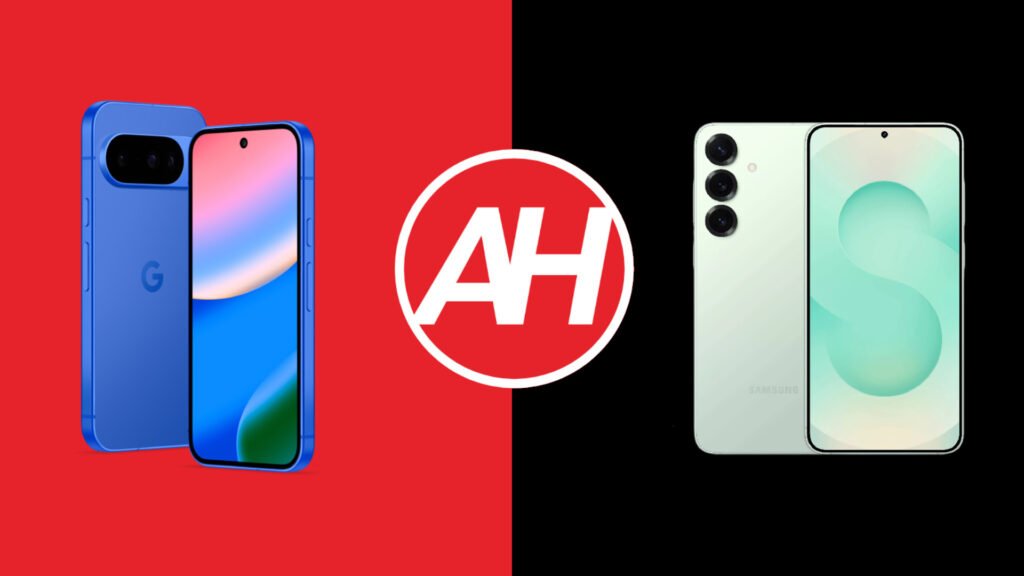

Both Google and Samsung announced quite a few compelling devices in 2025. The Google Pixel 10 is the most affordable Pixel 10 smartphone currently available, and in this article, we’ll compare it with one of the devices from Samsung’s (still) flagship series. In other words, we’ll be comparing the Google Pixel 10 vs Samsung Galaxy S25+. The Galaxy S26 series is right around the corner, but at the time of writing this article, the Galaxy S25 series is still at the top.
With that being said, we’ll first list the specifications of both smartphones. Following that, we’ll compare their designs, displays, performance, battery life, cameras, and audio output. These two phones are considerably different, both in terms of design, size, and internals. So, let’s see what they have to offer, shall we?
Specs

Google Pixel 10

Samsung Galaxy S25+
| Google Pixel 10 | Samsung Galaxy S25+ | |
|---|---|---|
| Dimensions | 152.8 x 72 x 8.6mm | 158.4 x 75.8 x 7.3 mm |
| Weight | 204 grams | 190 grams |
| Display | 6.3-inch Actua OLED display | 6.7-inch Dynamic LTPO AMOLED 2X |
| Refresh rate | Smooth Display (60-120Hz) | 1-120Hz (adaptive) |
| Resolution | 2424 x 1080 | 3120 x 1440 |
| Chipset | Google Tensor G5 | Qualcomm Snapdragon 8 Elite for Galaxy |
| RAM | 12GB (LPDDR5X) | 12GB LPDDR5X |
| Storage | 128GB/256GB | 256GB/512GB (UFS 4.0) |
| Main camera | 48MP (f/1.7 aperture, 1/2.0-inch sensor size, 82-degree FoV) | 50MP (wide, f/1.8 aperture, 1/1.56-inch sensor size, 1.0um pixel size, dual pixel PDAF, OIS) |
| Ultra-wide camera | 13MP (f/2.2 aperture, 1/3.1-inch sensor size, 120-degree FoV) | 12MP (f/2.2 aperture, 1/2.55-inch sensor size, 120-degree FoV, 1.4um pixel size) |
| Telephoto camera | N/A | 10MP (f/2.4 aperture, 1/3.94-inch sensor size, 1.0um pixel size, PDAF, OIS, 3x optical zoom) |
| Periscope telephoto camera | 10.8MP (f/3.1 aperture, 1/3.2-inch sensor size, 5x optical zoom, 23-degree FoV) | N/A |
| Selfie camera | 10.5MP (f/2.2 aperture, 95-degree FoV) | 12MP (f/2.2 aperture, 1/3.2-inch sensor size, 1.12um pixel size) |
| Battery size | 4,970mAh | 4,900mAh |
| Charging | 30W wired, 15W Qi2 wireless (charger not included) | 45W wired, 15W wireless (Qi2 Ready), 4.5W reverse wireless (charger not included) |
| Colors | Indigo, Frost, Lemongrass, Obsidian | Icy Blue, Mint, Navy, Silver Shadow, Pink Gold, Coral Red, Blue Black |
Google Pixel 10 vs Samsung Galaxy S25+: Design
These two phones are most similar when you look at them from the front. They have a similar shape and flat displays. On top of those displays sits a display camera hole, which is centered. The bezels are uniform on both phones, but they’re thinner on the Galaxy S25+. The corner curvature is similar, but a bit more pronounced on the Pixel 10. Both smartphones also have a flat frame all around.
All of their physical buttons sit on the right-hand side. The power/lock button is placed above the volume rocker keys on the Pixel 10. It’s the other way around on the Galaxy S25+. If we flip them around, you’ll notice that both devices have flat backplates. Both of them also have glass on the back, not plastic. The Pixel 10 includes a horizontal camera visor on the back, which is centered towards the top of the backplate. The Galaxy S25+, on the other hand, includes three separate protrusions for its cameras, and they’re vertically aligned in the top-left corner.
The Galaxy S25+ does wobble on the table, unlike the Pixel 10, in case you were wondering. The Galaxy S25+ is also a noticeably larger smartphone, as it has a larger display. It’s taller, wider, and thinner than the Pixel 10. It’s also lighter, which is quite interesting. It’s lighter by 14 grams despite being considerably bigger. Both phones offer an IP68 certification for water and dust resistance. Both of them are also quite slippery in the hand.
Google Pixel 10 vs Samsung Galaxy S25+: Display
The Google Pixel 10 features a 6.3-inch OLED display. That panel is flat, and it supports HDR10+ content. The peak brightness it offers is 3,000 nits. The screen-to-body ratio here is around 86%, while the display aspect ratio is 20:9. The Pixel 10 offers a resolution of 2424 x 1080 pixels. The Gorilla Glass Victus 2, from Corning, protects this display.

The Samsung Galaxy S25+, on the other hand, features a 6.7-inch Dynamic LTPO AMOLED 2X display. That panel has a refresh rate of up to 120Hz and supports HDR10+ content. The peak brightness here is 2,600 nits. The screen-to-body ratio here is 91.8%, while the display aspect ratio is 19.5:9. This phone offers a resolution of 3120 x 1440 pixels, and its display is protected by the Gorilla Glass Victus 2 from Corning.
Both of these displays are quite good. They’re not amongst the best on the market, but they’re quite good, and not many people will have complaints here. Both panels are vivid, sharp, and have good viewing angles. The touch response is also good. The Pixel 10’s panel is technically slightly brighter, but you won’t lack brightness on either one, at least we didn’t.
Google Pixel 10 vs Samsung Galaxy S25+: Performance
The Google Tensor G5 processor fuels the Google Pixel 10. That is the very first Tensor chip made by TSMC. It’s a 3nm processor. That processor is paired with 12GB of RAM and UFS 3.1 or UFS 4.0 flash storage. The phone’s 128GB storage option comes with UFS 3.1 memory, while its 256GB counterpart offers UFS 4.0 memory. You cannot expand that storage, so keep that in mind.
The Samsung Galaxy S25+, on the other hand, is fueled by the Snapdragon 8 Elite processor from Qualcomm. That is also a 3nm chip, and it’s more powerful than the Tensor G5. That chip is paired with 12GB of LPDDR5X RAM inside the Galaxy S25+, while both of its storage variants come with UFS 4.0 memory. The storage is not expandable here either.
Both of these smartphones offer good performance, though. The Galaxy S25+ may be able to open apps a split second faster, but they’re generally both quite snappy. The Galaxy S25+ is the better option for gaming, that’s for sure, even though you can run games on the Pixel 10 just fine. They can both handle rather intense use on a daily basis, including heavy multitasking, so no worries there. We did not notice overheating or anything of the sort.
Google Pixel 10 vs Samsung Galaxy S25+: Battery
There is a 4,970mAh battery included inside the Google Pixel 10. The Samsung Galaxy S25+, on the other hand, comes with a 4,900mAh battery. The Samsung Galaxy S25+ does have a considerably larger display and smaller battery than the Pixel 10, and yet it manages to offer better battery life. In fact, it’s a noticeably better battery life. We were able to get around 15-20% more screen-on time with the Galaxy S25+.
Samsung obviously did a great job optimizing the Galaxy S25+. While the battery life is really, really good, it’s nowhere near the best smartphones in the category. It will be more than enough for the vast majority of people, though. If you’re the ultimate power user, well, then you may need to top it off before the end of the day. We’ve also noticed that the Pixel 10’s battery does deplete a bit faster during gaming sessions.
The Google Pixel 10 supports 30W wired, 15W wireless (Qi2), and reverse wired charging. The Galaxy S25+, on the other hand, supports 45W wired, 15W wireless (Qi2 Ready), and 4.5W reverse wireless charging. Neither phone ships with a charger, but if you get a compatible charger to take full advantage of said speeds, the Pixel 10 can be fully charged in an hour and a half. The Galaxy S25+ can get there noticeably faster, in an hour.
Google Pixel 10 vs Samsung Galaxy S25+: Cameras
The Google Pixel 10 has three cameras on the back. A 48-megapixel main camera (1/2.0-inch sensor size) is backed by a 13-megapixel ultrawide snapper (1/3.1-inch sensor size, 120-degree FoV). The third camera on the back of the phone is a 10.8-megapixel telephoto unit (1/3.2-inch sensor size, 5x optical zoom).

The Samsung Galaxy S25+, on the other hand, also has three cameras on the back. Its 50-megapixel main camera (1/1.56-inch sensor size) is backed by a 12-megapixel ultrawide snapper (1/2.55-inch sensor size, 120-degree FoV). The third camera on the back is a 10-megapixel telephoto unit (1/3.94-inch sensor size, 3x optical zoom).
Neither of these two phones exactly has great camera hardware. They do offer good results, though. The images from the Pixel 10 are a bit more contrasty, while the Galaxy S25+ loves to tune up the saturation at times. We prefer the Pixel 10’s results in low light, more often than not, especially with its secondary cameras. The Galaxy S25+ does a great job with its main camera, though.
Audio
There are stereo speakers included on both of these phones. They are actually quite similar in terms of loudness, while the sound output quality is good from both smartphones as well. There’s not much to complain about.
You will not find an audio jack on either of these two phones, though. You can always utilize their Type-C ports to connect your wired headphones, though. Alternatively, Bluetooth 6.0 is supported by the Pixel 10, while the Galaxy S25+ supports Bluetooth 5.4.
The post Phone Comparisons: Google Pixel 10 vs Samsung Galaxy S25+ appeared first on Android Headlines.