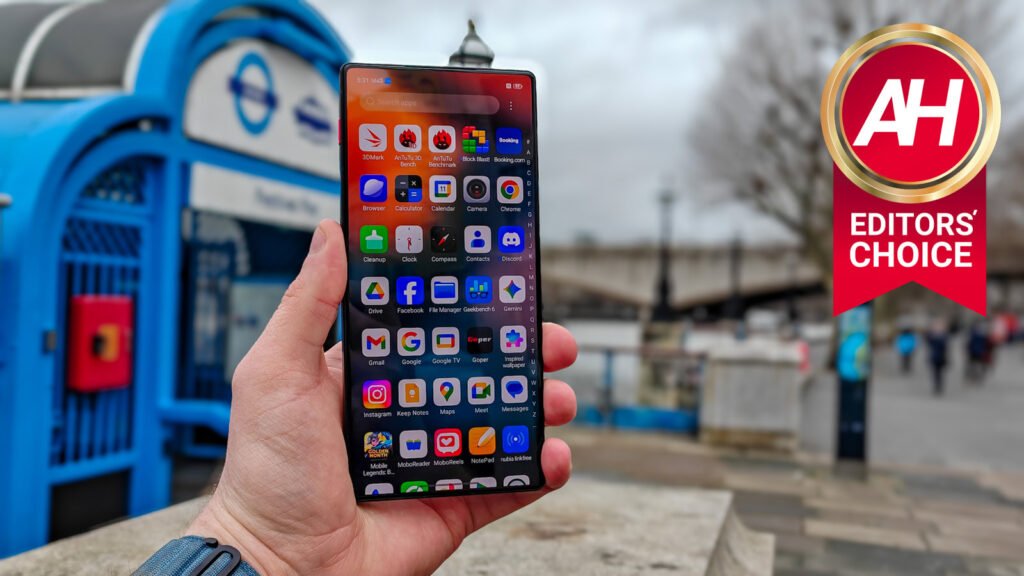

RedMagic seems to be the only brand really making good gaming phones that people actually want to buy. Late last year, they launched the RedMagic 11 Pro, which sports the latest Snapdragon 8 Elite Gen 5. But what about people who want a slightly cheaper gaming phone? That’s where the RedMagic 11 Air comes in. This is powered by last year’s Snapdragon 8 Elite, and costs just $499 here in the US.
To hit this price point, surely RedMagic (who’s parent-company is ZTE) had to cut some corners, right? Well, actually, it looks like that wasn’t the case. But let’s find out the good, the bad, and the ugly about the RedMagic 11 Air in our full review.

The RedMagic 11 Air packs flagship power, a massive battery, and that signature translucent design, all for just $499
Pros
- Stunning, saturated 6.85-inch AMOLED display with 144Hz refresh rate and 2592Hz PWM dimming
- Unique translucent design that’s hard to put down
- Snapdragon 8 Elite still performs incredibly well, with no hiccups in daily use or gaming
- Massive 7,000mAh battery that easily gets through a full day, even with extra gaming
- 80W USB-C PD charging — no proprietary USB-A nonsense
- Clean software with minimal bloatware
Cons
- No wireless charging
- Camera is just fine; nothing special, and no telephoto lens
- No 2x crop or full 50MP shooting mode, which feels like a missed opportunity
- Tactical Coach AI feature is underwhelming in its current state

RedMagic 11 Air Specs
RedMagic 11 Air Specs
| Dimensions | 163.8 x 76.5 x 8mm |
| Weight | 207g |
| Display | 6.85″ 2688×1216; AMOLED 144Hz |
| Processor | Qualcomm Snapdragon 8 Elite |
| Memory/Storage | 12GB/256GB; 16GB/512GB |
| Battery | 7,000mAh |
| Charging | 80W wired |
| Cameras | 50MP primary; 8MP ultrawide; 16MP under-display front-facing |
| Colors | Phantom (Transparent Black), Prism (Transparent White) |
RedMagic 11 Air Review: Build and Design
Starting off with the design, the RedMagic 11 Air has virtually the same design as the rest of RedMagic’s recent phones. It’s mostly a rectangle with flat sides and sharp corners, with a translucent glass back. It does still keep the fan on the back and some RGB lighting. Honestly, the backside of this phone is one of the more unique phones I’ve reviewed in a while. While the front reminds me of virtually every other Nubia phone I’ve reviewed recently.
Don’t get me wrong, the phone looks great. And honestly, it’s been hard to put down because of how great the phone looks. The 2.5D curved glass on the backside makes it very easy to hold in your hand, too. While gaming or just browsing Threads.


The Magic Slider from previous RedMagic phones is now a button, and it keeps the same red color and textured appearance as well. RedMagic also kept the two capacitive shoulder triggers, but they are not RGB like they are in the RedMagic 11 Pro. RedMagic also changed the fan on the 11 Air. So it is now sucking air from the circular back opening, which looks like a camera, rather than using a channel going across the phone.
RedMagic continues to give us brilliant-looking displays with very small bezels, and even includes a camera under the display. Something that even Samsung has ditched now with the Galaxy Z Fold 7. But more on that display in a moment.
The company also provides a charger and a plastic case in the box. The case is a nice addition, though I can’t say I’ve used it at all while using the RedMagic 11 Air, but for those that want some protection, it’s nice to have. Especially since lesser-known devices can be quite tough to find cases for.
Overall, the RedMagic 11 Air is still a very unique-looking device, and the build quality is top-notch.
RedMagic 11 Air Review: Display
ZTE devices like those from RedMagic and nubia have had some really incredible displays over the years, and that’s no different with the RedMagic 11 Air. This is a 6.85-inch AMOLED display with a 144Hz refresh rate. It also has really good PWM for dimming at 2592Hz, which is great for those who suffer from the low PWM of a lot of other flagships. It is also sporting some very thin bezels here, resulting in a 90.7% screen-to-body ratio. Which helps it look incredible.
This display gets plenty bright at 1800nits of peak brightness. Sure, it’s not the same high number as a lot of other phones, but 1800nits of peak brightness is plenty to see it outdoors in direct sunlight. I’ve had no problem seeing it in the winter here in Michigan, where it’s actually brighter than normal thanks to the sun reflecting off the snow.

The colors on this display are simply stunning. Going from other devices to the RedMagic 11 Air was really eye-opening. I’ve been using the OPPO Find N5 and Find X9 Pro recently, and there’s a huge difference with what RedMagic has here. It’s a lot more saturated than other panels, which I actually prefer. Of course, this is an AMOLED display, and it’s a 10-bit display, which allows it to show more colors. Something that Samsung doesn’t even have (yet).
RedMagic 11 Air Review: Performance
Now let’s talk about performance. This is a chipset that I’m very familiar with, having powered a lot of the flagship phones I reviewed in 2025. It’s the Qualcomm Snapdragon 8 Elite. Which is paired with 16GB of RAM and 512GB of storage. There is a 12GB/256GB model available, too, but we have the higher-end SKU for review.
The Snapdragon 8 Elite performs just as you would expect; it’s very snappy and does get a bit warm. But remember, RedMagic is pushing it further here, since we do have that fan inside. In daily usage, I didn’t really notice any sorts of hiccups, slowdowns, or anything like that. The phone didn’t even really get that warm, even while doing benchmarks – except for the 3D Mark Wildlife Extreme Stress Test of course.
For the usual gambit of browsing Twitter, Facebook, Threads, etc., it works perfectly fine. And even when gaming the phone is still very snappy. Playing games like Genshin Impact and MLBB, the RedMagic 11 Air performed extremely well. Even after a couple of hours of MLBB at full brightness, the phone was still quite cool. And the battery held up quite well too.
Benchmarks
For every phone that we review, we also run it through a number of benchmarks to compare to other devices we’ve reviewed. This includes Geekbench 6, AnTuTu, and 3D Mark Wild Life Extreme Stress Test. But for the RedMagic 11 Air, we’re doing things a bit differently, because there is that fan.
So, because we have this fan inside, and we want to see how much of a difference it actually makes to the benchmark scores and thermal temps, we are running each benchmark with the fan on and with it off. We are not running them back-to-back. Instead, it will cool back down to room temperature before running the next round. To make it as fair as possible.
| Device | Geekbench CPU Single-Core | Geekbench CPU Multi-Core | Geekbench GPU |
|---|---|---|---|
| RedMagic 11 Air (fan on) | 3,133 | 10,105 | 19,558 |
| RedMagic 11 Air (fan off) | 3,054 | 9,819 | 19,553 |
| RedMagic 10 Pro | 3,129 | 9,621 | 19,737 |
| HONOR Magic 8 Pro | 3,637 | 9,419 | 23,965 |
| Google Pixel 10 Pro XL | 2,267 | 6,034 | 2,948 |
Above, we are comparing it to the RedMagic 10 Pro, which is essentially the same specced device, as it came out last year. As well as the HONOR Magic 8 Pro, which has the Snapdragon 8 Elite Gen 5, and the Google Pixel 10 Pro XL with the Tensor G5 processor. Unfortunately, RedMagic did not send us the 11 Pro to review, so we can’t compare it to their current flagship.
| Device | Best Loop | Lowest Loop | Stability | Temperature |
|---|---|---|---|---|
| RedMagic 11 Air (fan on) | 6,840 | 5,470 | 80% | 121.1°F |
| RedMagic 11 Air (fan off) | 6,881 | 5,468 | 79.5% | 128.8° |
| RedMagic 10 Pro | 5,887 | 4,281 | 72.7% | 112.6° |
| HONOR Magic 8 Pro | 7,083 | 4,488 | 63.4% | 118.3° |
| Google Pixel 10 Pro XL | 3,264 | 1,839 | 56.3% | 109° |
Next up is 3D Mark Wildlife Extreme Stress Test. This benchmark is designed to push the device to its absolute limit, running 20 rounds of the same 60-second benchmark. This is going to be the hottest that this device will likely ever get. Which is a good way for us to judge the temperature here and any thermal limits.
As you can see, it did get quite a bit warmer, almost 9 degrees warmer. It also got so warm that on the last loop, the screen dimmed so much I could barely even see it. Not quite hot enough to crash the benchmark, thankfully. Despite that rise in temperature, the results were almost identical. With stability only dropping a half percent.
| Device | AnTuTu Score |
|---|---|
| RedMagic 11 Air (fan on) | 3,254,404 |
| RedMagic 11 Air (fan off) | 3,282,255 |
| RedMagic 10 Pro | 3,102,960 |
| HONOR Magic 8 Pro | 4,288,382 |
| Google Pixel 10 Pro XL | 1,240,243 |
Finally, we have AnTuTu, which is aimed at showing us how good the entire package of the RedMagic 11 Air is. This is going to test out every part of the device and give us a final score. Most Snapdragon 8 Elite devices were around 3 million, while Snapdragon 8 Elite Gen 5 devices have pushed past the 4 million mark here. So these scores are pretty spot on.
Overall, the performance is quite good here. And we can tell that there is a difference with the fan on and the fan off. So despite it sounding like it’s a gimmick, it actually does make a difference. The most notable difference is in the 3D Mark Wildlife Extreme Stress Test. But it looks like the fan doesn’t do a whole lot other than sustained performance. The results are identical with the fan on and with it off.
RedMagic 11 Air Review: Battery Life and Charging
As with most gaming phones, RedMagic has packed in a pretty massive battery here. We’re talking a 7,000mAh capacity battery, which is actually still smaller than the OnePlus 15. But don’t worry, battery life is still really good. It’s been able to get through a full day of usage for us with no problem, and that included extra gaming that we wouldn’t normally be doing – since this is a gaming phone.
The 7,000mAh battery inside can easily get you through a day, a long gaming session, or even a weekend if you’re a light user. Obviously, having the fan on is going to result in more juice being taken out of the battery. But there is the trade-off of keeping your phone cooler, so it kind of evens out.

RedMagic does have fast charging here, and we’re talking USB-C and not a proprietary USB-A charger like a lot of other Chinese brands. This is going to be 80W of USB-C PD charging in the US, and China gets 120W. That’s really fast, especially for USB-C PD. Most other phones with faster charging are doing so over USB-A.
The only complaint as far as charging goes, comes down to the lack of wireless charging. But honestly, I haven’t missed it. And this comes from someone who charges their iPhone over MagSafe religiously. With 80W wired charging, it’s just not something I think about often.
Benchmarks
As is the case with performance, we also run a benchmark for battery life and charging. For battery life, we charge the phone to 100% and let it sit for about an hour to make sure it is truly at 100%. Then load up a YouTube video, set the brightness to about 150nits and turn off auto-brightness. Start playing the video and unplug the device, timing how long it takes to deplete.
The RedMagic 11 Air didn’t do quite as well as I was expecting, but it did cross 20 hours with a time of 20 hours and 45 minutes. That’s lower than a lot of other phones, but I believe the reason for this is because it is more optimized for gaming and less optimized for video playback.
Now on the charging front, after the battery life test completes, we then plug it in using the charger included in the box (or one that can max out the charging speed if one wasn’t provided). And time how long it takes to go from dead to 1%, up to 100%.
Our results were just over an hour for a full charge. It was 1 hour and 3 minutes. A bit slower than I was expecting, given it is 80W charging, but that’s still not too shabby when you think about the fact that this is a 7,000mAh battery.
RedMagic 11 Air Review: Software
The RedMagic 11 Air is running RedMagic OS 11, which is based on Android 16. And honestly? It’s pretty much what you’d expect from a RedMagic phone at this point. If you’ve used any of the recent RedMagic devices, you’re going to feel right at home here. The skin hasn’t changed a whole lot visually from previous versions, and that’s not necessarily a bad thing. It’s clean, it stays out of the way for the most part, and Nubia has done a good job keeping the bloatware to a minimum. You’re not going to be spending 20 minutes after setup uninstalling apps you never asked for, which is always appreciated.

Now, let’s talk about the elephant in the room: Artificial Intelligence. Everyone and their mother is shoving AI into their phones these days, and RedMagic is no exception. You’ve got Google Gemini baked in, which comes standard on pretty much every Android phone at this point, and then there’s Mora, RedMagic’s own virtual assistant. Look, Mora is… an acquired taste. It’s very anime-coded, very Genshin Impact energy, and it’s just not for me. But hey, if that’s your thing, more power to you. Outside of Mora and Gemini, the AI suite here is pretty barebones compared to what Samsung and Google are doing with their flagships. There’s a RedMagic AI+ section in the settings with some basic tools like live translation and image generation, but nothing that’s going to blow your mind.
Where the software really earns its keep is Game Space, and this has been a RedMagic staple for years now. Hit that dedicated red button on the side of the phone, and you’re dropped into a dedicated game launcher that automatically populates with your installed titles. From there, you can tweak performance profiles, mess with the shoulder trigger sensitivity, adjust visual enhancements, monitor your FPS and CPU/GPU stats in real-time with an in-game overlay – it’s a gamer’s playground.
New this time around are some AI-powered features like a Tactical Coach that’s supposed to give you real-time strategy tips in games like PUBG Mobile, Free Fire, and Mobile Legends. I gave it a shot, and honestly, it’s pretty underwhelming right now. Mora basically just told me to go to a location on the map, which… yeah, that’s kind of the whole point of a battle royale. It’s clearly early days for this feature, so hopefully it gets better with future updates. There’s also voice command mapping and a Mora Mouthpiece feature that can respond to in-game chat on your behalf, which is a neat idea even if the execution still needs some work.
As for software updates, this is where things get a little murky. If you’re in the EU or UK, you’re looking at five years of software support thanks to regulations over there. Everyone else? Three years, which includes major Android updates and security patches. That’s not bad for a gaming phone at this price point, but it is behind what Samsung, Google, and even HONOR offer for their flagship devices. In fact, the EU is only getting five years of updates thanks to the European Union demanding it.
RedMagic 11 Air Review: Camera
Typically, the downside to gaming phones is the camera. RedMagic has done a good job at improving the cameras on its smartphones, but it’s still not going to compete with the likes of the vivo X300 Pro, or the Google Pixel 10 Pro XL. In fact, it doesn’t even sport a telephoto lens.
| Camera | Specs |
|---|---|
| Primary | 50MP f/1.9 1/1.55″ |
| Ultrawide | 8MP f/2.2 1/4″ |
| Front-Facing | 16MP f/2.0 1/2.77″ |
As you can see from the hardware specs above, the primary camera should be pretty decent. But the ultrawide is quite lacking, especially with how tiny it is. I don’t know the last time I saw a camera that was 1/4″, that’s not one over something point four, no four inches. It’s freaking tiny. Thankfully, I don’t use the ultrawide all that much, so it’s not a huge deal. The front-facing camera also has a pretty decent-sized sensor.

Enough about the hardware, how do the actual images look from these cameras? Below, you’ll find a gallery of images I’ve taken with the RedMagic 11 Air, and they’re….fine. Not my favorite camera, but I’ve definitely used far worse cameras recently.


One of the surprising things here for me, is the fact you can’t get a 2x photo, easily. There’s no sensor cropping on the main sensor, which is a bit surprising since the main sensor is 50-megapixels. The camera does still pixel bin to 13.6 megapixels, which makes it even stranger. There is a way to shoot at full resolution, and surprisingly, there’s little to no lag here. However, the mode is buried under “Camera Family” unfortunately. All of this is leading me to believe that RedMagic could definitely do more here. You can pinch-to-zoom like usual to get further zoom, but anything past 1x looks like digital zoom, unfortunately. The few 5x photos I took looked absolutely horrendous.
Should you buy the RedMagic 11 Air?
At the end of the day, the RedMagic 11 Air is a really impressive package for the money. You’re getting a Snapdragon 8 Elite, a gorgeous 144Hz AMOLED display, a 7,000mAh battery, and a built-in cooling fan — all for just $499. That’s less than what a Pixel 9a was at launch, and you’re getting significantly more phone here. Sure, it’s running last year’s flagship chipset, but the Snapdragon 8 Elite is still an absolute beast, and unless you’re obsessing over benchmark numbers, you’re not going to notice the difference in everyday use or gaming.
That said, this is still very much a gaming phone first and everything else second. The cameras are serviceable but nothing to write home about, software updates lag behind the big players, and there’s no wireless charging. But if you’re someone who games on their phone regularly, or you just want a ton of performance without dropping $1,000+, the RedMagic 11 Air is really hard to beat at this price. RedMagic continues to carve out a space that no one else is really competing in, and honestly, they’re doing a damn good job at it.

You should buy the RedMagic 11 Air if:
- You want flagship-level performance without the flagship price tag.
- You play games on your smartphone daily.
- You want a massive battery that can handle long gaming sessions and still get you through the day
- You want a clean software experience without a ton of bloatware
You should not buy the RedMagic 11 Air if:
- You need wireless charging in your life
- You need a top-notch camera setup
- You’re not a gamer and would rather have a more well-rounded phone
The post RedMagic 11 Air Review: This $499 Gaming Phone Has No Business Being This Good appeared first on Android Headlines.