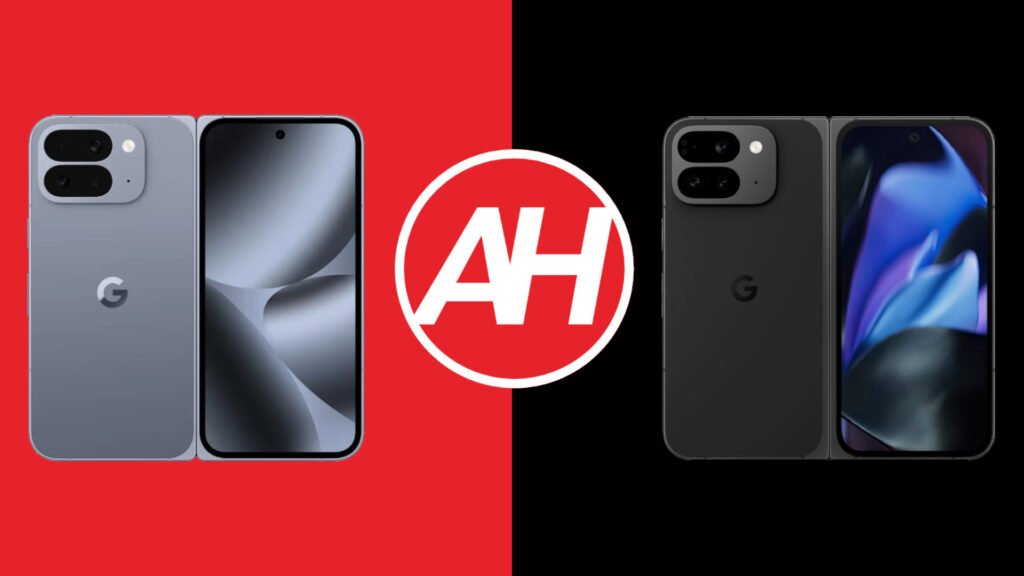

This time around, we’re comparing two foldable phones from Google. It’s a Google Pixel 10 Pro Fold vs Google Pixel 9 Pro Fold comparison. The Pixel 10 Pro Fold is the latest and greatest foldable that the company has to offer, and the third one overall. The Pixel 9 Pro Fold is, needless to say, its predecessor, which was announced in 2024. These two phones do have similar form factors and look very similar overall.
In fact, they’re quite similar overall; Google did not exactly reinvent the wheel from the Pixel 9 Pro Fold to the Pixel 10 Pro Fold. We’ll kick things off by listing the specs of both phones, and will then compare them across a number of different categories. We’ll compare their designs, displays, performance, battery life, cameras, and audio output.
Specs

Google Pixel 10 Pro Fold

Google Pixel 9 Pro Fold
| Google Pixel 10 Pro Fold | Google Pixel 9 Pro Fold | |
|---|---|---|
| Dimensions (unfolded/folded) | 155.2 x 150.4 x 5.2 mm / 155.2 x 76.3 x 10.8 mm | 155.2 x 150.2 x 5.1 mm / 155.2 x 77.1 x 10.5 mm |
| Weight | 258 grams | 257 grams |
| Main display | 8-inch Foldable LTPO OLED (1-120Hz) | 8-inch Foldable LTPO OLED (up to 120Hz) |
| Cover display | 6.4-inch OLED (120Hz) | 6.3-inch Foldable LTPO AMOLED (up to 120Hz) |
| Resolution | 2076 x 2152 / 2364 x 1080 | 2152 x 2160 / 2424 x 1080 |
| Chipset | Google Tensor G5 | Google Tensor G4 |
| RAM | 16GB (LPDDR5X) | 16GB (LPDDR5X) |
| Storage | 256GB/512GB/1TB (UFS) | 256GB/512GB (UFS 3.1) |
| Main camera | 48MP (f/1.7 aperture, 1/2.0-inch sensor size, 0.8um pixel size, dual pixel PDAF, OIS | 48MP (f/1.7 aperture, 1/2.0-inch sensor size, 0.8um pixel size, dual pixel PDAF, OIS |
| Ultra-wide camera | 10.5MP (f/2.2 aperture, 1/3.4-inch sensor size, 127-degree FoV, PDAF) | 10.5MP (f/2.2 aperture, 1/3.4-inch sensor size, 127-degree FoV, PDAF) |
| (Periscope) telephoto camera | 10.8MP (telephoto, f/3.1 aperture, 1/3.2-inch sensor size, dual pixel PDAF, OIS, 5x optical zoom) | 10.8MP (telephoto, f/3.1 aperture, 1/3.2-inch sensor size, dual pixel PDAF, OIS, 5x optical zoom) |
| Selfie camera | 10MP (f/2.2 aperture, 1/3.94-inch sensor size, PDAF) x2 | 10MP (f/2.2 aperture, 1/3.94-inch sensor size, PDAF) x2 |
| Battery size | 5,015mAh | 4,650mAh |
| Charging | 30W wired, 15W wireless (Qi2), Bypass charging (charger not included) | 21W wired, 7.5W wireless (charger not included) |
| Colors | Moonstone, Jade | Obsidian, Porcelain |
Google Pixel 10 Pro Fold vs Google Pixel 9 Pro Fold: Design
Design-wise, they look very similar. Their dimensions are almost the same, and that goes for every aspect of them. Some people would also have a hard time recognizing which is which just by looking at them. The main display on both phones has a display camera hole in the top-right corner, while the cover display has a display camera hole centered at the top. The corner curvature is basically the same across these two phones.
They both come with an aluminum frame and a glass back. They are quite thin when unfolded, but when folded, they’re a bit thicker than the thinnest foldables out there. They’re also quite a bit heavier than the likes of other flagship book-style foldables, as the Pixel 10 Pro Fold and Pixel 9 Pro Fold weigh 258 and 257 grams, respectively. The power/lock and volume up and down keys are placed on the right-hand side of both phones. The power/lock button sits above the volume keys.
On the back of both phones, you’ll notice a camera module in the top-left corner. That camera module is squarish on both devices and includes three cameras. The camera modules are actually quite similar-looking. Both phones have a flat back. The Pixel 10 Pro Fold has the advantage of an IP68 rating, while the Pixel 9 Pro Fold is only IPX8 rated. The Pixel 10 Pro Fold is actually the very first foldable to offer a proper IP68 certification. Both phones are quite slippery in the hand, by the way.
Google Pixel 10 Pro Fold vs Google Pixel 9 Pro Fold: Display
The Google Pixel 10 Pro Fold features an 8-inch Foldable LTPO OLED main display with a refresh rate of up to 120Hz. That display supports HDR10+ content, and it has a peak brightness of 3,000 nits. The screen-to-body ratio here is around 88%. The resolution is 2076 x 2152, while the ratio is 1:1. The cover display measures 6.4 inches, and it’s an OLED panel with a 120Hz refresh rate. HDR content is supported, while the Gorilla Glass Victus 2 protects it. The resolution here is 2364 x 1080 pixels, and the peak brightness is 3,000 nits.

The Google Pixel 9 Pro Fold, on the flip side, has the same main display size as the Pixel 10 Pro Fold. In fact, its main display is the same as the one on the Pixel 9 Pro Fold in every way, except for the fact that it’s slightly less bright. The cover display measures 6.3 inches, and it offers a resolution of 2424 x 1080 pixels. It’s an OLED panel with a 120Hz refresh rate and Gorilla Glass Victus 2 protection. Yes, HDR content is supported here, and the peak brightness is 2,700 nits.
All four of these displays are actually quite good and do the job. They’re bright enough, vivid, and have good viewing angles. All four displays are also more than sharp enough, so there’s no problem there either. The crease on the main displays is not exactly noticeable when you’re looking at them head-on. Yes, there are better displays out there, but these are more than good enough.
Google Pixel 10 Pro Fold vs Google Pixel 9 Pro Fold: Performance
The Google Tensor G5 SoC fuels the Pixel 10 Pro Fold. That is Google’s 3nm processor, and the first Tensor chip made by TSMC. That processor is backed by 16GB of LPDDR5X RAM here, and UFS storage is used. This smartphone does not offer microSD storage expansion, by the way.
The Google Pixel 9 Pro Fold, on the other hand, is fueled by the Tensor G4 processor from Google. That is a 4nm chip, and it’s made by Samsung. It is backed by 16GB of LPDDR5X RAM as well, along with UFS 3.1 flash storage. This smartphone does not support storage expansion either.
Both smartphones work really well. When you compare them side-by-side, you will notice that the Pixel 10 Pro Fold is a bit faster in some aspects during day-to-day use. Both are snappy enough in general, though, and the Pixel 9 Pro Fold still performs admirably. If you’re planning on tackling some games, though, the Pixel 10 Pro Fold is the better call, even though neither phone is made for gaming. We did not notice overheating issues with either one of them, though.
Google Pixel 10 Pro Fold vs Google Pixel 9 Pro Fold: Battery
There is a 5,015mAh battery included inside the Pixel 10 Pro Fold. The Pixel 9 Pro Fold, on the other hand, includes a 4,650mAh unit. It’s nice to see that Google included a larger battery in the new model, and yes, that phone does offer better battery life. Just to be clear, neither phone offers great battery life. For most people, it will be enough, but for power users, not really, that especially goes for the Pixel 9 Pro Fold.
Yes, the Pixel 10 Pro Fold does add some longevity to the table, but not all that much. You’ll be able to get around half an hour extra screen-on time, at least that was the case for us. That’s just a rough estimate, of course, but the point is, the newer model does not add that much more in the battery department. There are book-style foldables out there that offer notably better battery life than both of these.
The Pixel 10 Pro Fold supports 30W wired and 15W wireless charging (Qi2). The Pixel 9 Pro Fold, on the other hand, supports 21W wired and 7.5W wireless charging. Neither phone comes with a charger in the box, though. It takes the Pixel 9 Pro Fold a bit over an hour and a half to fully charge, while the Pixel 10 Pro Fold’s charging is not far from that point either. They both take around an hour and 35 minutes to fully charge. The Pixel 10 Pro Fold may offer a bit faster charging, but it also has a larger battery to charge.
Google Pixel 10 Pro Fold vs Google Pixel 9 Pro Fold: Cameras
Not only do both of these phones have three cameras on the back and one camera on each display, but the camera hardware is identical in comparison. Yes, that goes for all five cameras here. There is a 48-megapixel main camera (1/2.0-inch sensor size), which is backed by a 10.5-megapixel ultrawide unit (1/3.4-inch sensor size). The third camera on the back is a 10.8-megapixel telephoto unit (1/3.2-inch sensor size).

When it comes to selfie cameras, they’re the same on the main and cover displays. Both phones use a 10-megapixel selfie shooter (1/3.94-inch sensor size). The images that the two phones provide do look very similar, which is unsurprising. The results are good, though not great. Considering the hardware, both phones do a good job, though the hardware is not the best.
The images do end up looking contrasty, as we’re used to from Pixel phones. They also look processed and unrealistic, and are not on the same level as the images from Google’s Pixel 10 flagships. For most people, however, these cameras will do the trick. Don’t expect miracles, though, the hardware is quite limited, and Google’s software can only do so much.
Audio
You’ll find stereo speakers on both of these phones, and those speakers are actually good. The loudness is basically the same, and the sound output quality is on a high level. The speakers are solid, not much to complain about.
There is no audio jack on either of these two smartphones. You can connect your headphones via the Type-C ports, though. Alternatively, Bluetooth 6.0 is supported on the newer model, while the older model comes with Bluetooth 5.3.
The post Phone Comparisons: Google Pixel 10 Pro Fold vs Google Pixel 9 Pro Fold appeared first on Android Headlines.