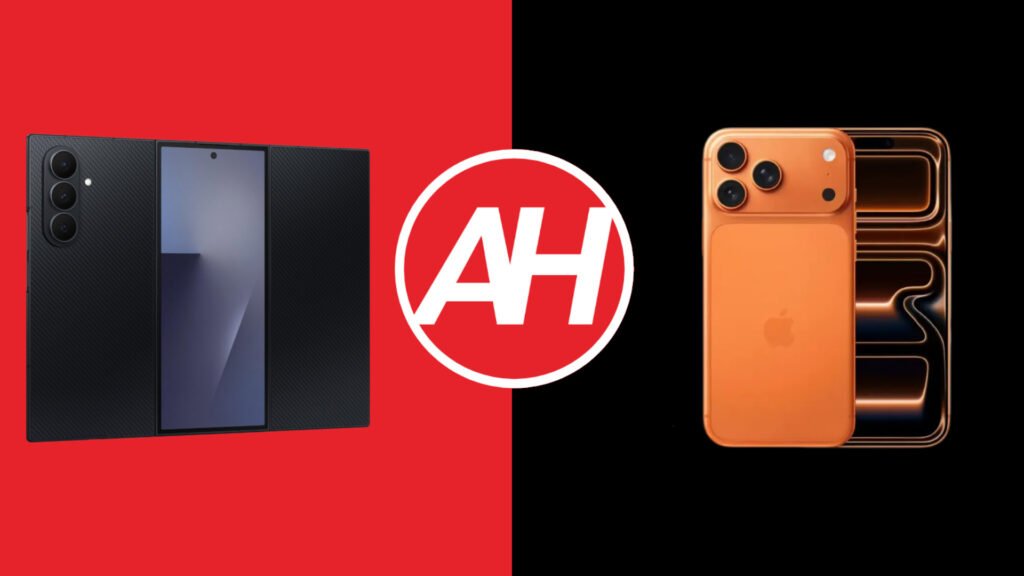

Samsung introduced its first tri-fold smartphone not long ago. We’ve compared it to a handful of devices thus far, and we’re here for yet another comparison. This time around, we’re comparing the Samsung Galaxy Z TriFold vs Apple iPhone 17 Pro Max. In other words, we’ll be comparing Samsung’s first tri-fold with the very best phone Apple has to offer. The company still doesn’t have a foldable, let alone a tri-fold, so we’re going with the regular flagship from Apple.
Needless to say, these two phones are very different. They’re as different as they can possibly be, actually. That should keep things fresh here. Just to note that we still haven’t reviewed the Galaxy Z TriFold, as it still hasn’t become available in global markets. We did have some hands-on time with the device, though. With that being said, let’s get down to business, shall we?
Specs

Samsung Galaxy Z TriFold

Apple iPhone 17 Pro Max
| Samsung Galaxy Z TriFold | Apple iPhone 17 Pro Max | |
|---|---|---|
| Dimensions (unfolded/folded) | 159.2 x 214.1 x 3.9-4.2 mm / 159.2 x 75 x 12.9 mm | 163.4 x 78 x 8.8 mm |
| Weight | 309 grams | 233 grams |
| Main display | 10-inch Dynamic LTPO AMOLED 2X (120Hz) | 6.9-inch LTPO Super Retina XDR OLED (120Hz) |
| Cover display | 6.5-inch Dynamic LTPO AMOLED 2X (120Hz) | N/A |
| Resolution | 2160 x 1584 / 2520 x 1080 | 2868 x 1320 |
| Chipset | Qualcomm Snapdragon 8 Elite for Galaxy | Apple A19 Pro |
| RAM | 16GB | 12GB |
| Storage | 512GB/1TB | 256GB/512GB/1TB/2TB |
| Main camera | 200MP (f/1.7 aperture, 1/1.3-inch sensor size, OIS, multi-directional PDAF) | 48MP (1/1.28 aperture, 1.22um pixel size, sensor-shift OIS, dual pixel PDAF) |
| Ultra-wide camera | 12MP (f/2.2 aperture, 1/2.55-inch sensor size, 120-degree FoV, dual pixel PDAF) | 48MP (f/2.2 aperture, 1/2.55-inch sensor size, 120-degree FoV, 0.7um pixel size, PDAF) |
| (Periscope) telephoto camera | 10MP (f/2.4 aperture, 1/3.94-inch sensor size, 3x optical zoom, OIS, PDAF) | 48MP (f/2.8 aperture, 1/2.55-inch sensor size, PDAF, 3D sensor-shift OIS, 4x optical zoom) |
| Selfie camera | 10MP (f/2.2 aperture, 1/3.0-inch sensor size) | aperture |
| Battery size | 5,600mAh | 4,832mAh (nano SIM) / 5,088mAh (eSIM only) |
| Charging | 45W wired, 15W wireless, 4.5W reverse wireless | 40W wired, 25W MagSafe wireless, 4.5W reverse wired (charger not included) |
| Colors | Crafted Black | Silver, Cosmic Orange, Deep Blue |
Samsung Galaxy Z TriFold vs Apple iPhone 17 Pro Max: Design
The moment you look at these two phones, you’ll realize how different they are. Even without the foldable aspect of the Galaxy Z TriFold, they simply look a lot different. The Galaxy Z TriFold has two flat displays, one of which is foldable. A display camera hole sits on both of them, while the frame is flat all around. The phone has a titanium hinge, fiber-reinforced polymer back, and an aluminum frame.
The Apple iPhone 17 Pro Max has a flat display too, with a Dynamic Island at the top aka a pill-shaped cutout. The bezels are uniform on both smartphones, though they’re a bit thinner on the iPhone 17 Pro Max. The frame on the iPhone is also flat all around, and it’s made out of aluminum. On the back, the phone has a glass panel. The Galaxy Z TriFold has a power/lock and volume up and down keys on the right, though are all its physical buttons. The iPhone 17 Pro Max has a power/lock button on the right, along with a Camera control key. The Action key is on the left, along with the volume keys.
When folded, the Galaxy Z TriFold has three cameras on the back. When unfolded, in addition to those three cameras, its cover display is on the back too, as is another empty backplate. It has three vertically-aligned cameras, which are on top of a camera island. The iPhone 17 Pro Max has three cameras on the back as well, though it also includes a camera bar and a recognizable iPhone Pro camera layout. It also has a two-tone design on the back, with different shades of the same color.
The Galaxy Z TriFold is IP48 certified for water and dust resistance. The iPhone 17 Pro Max comes with an IP68 certification. Samsung’s tri-fold is noticeably heavier, of course, while it’s also thicker when folded. Both phones are quite slippery in the hand, though.
Samsung Galaxy Z TriFold vs Apple iPhone 17 Pro Max: Display
The Samsung Galaxy Z TriFold has a 10-inch tri-foldable Dynamic LTPO AMOLED 2X main display. That panel has a refresh rate of up to 120Hz, while HDR content is supported. The peak brightness here is 1,600 nits. The screen-to-body ratio is at arou nd 90%, and the resolution is 2160 x 1584 pixels. The cover display measures 6.5 inches, and it’s a Dynamic LTPO AMOLED 2X panel as well. Its refresh rate also goes up to 120Hz, while the peak brightness is 2,600 nits. The Gorilla Glass Ceramic 2 protects this panel, while the resolution is 2520 x 1080 pixels. That panel is also flat.

The iPhone 17 Pro Max, on the other hand, includes a 6.9-inch LTPO Super Retina XDR OLED display. That display is flat, and it has a refresh rate of up to 120Hz. HDR10 is supported, as is Dolby Vision. The peak brightness that this display can offer is 3,000 nits. The screen-to-body ratio is at around 91%. The resolution here is 2868 x 1320 pixels, and the display aspect ratio is 19.5:9. The Ceramic Shield 2 protection is included on top of the display.
All four of these displays are very good, actually. They’re all sharp, vivid, and have good viewing angles. The foldable display on the Galaxy Z TriFold is a bit dimmer than the other two displays, but that’s not surprising. Still, based on what we’ve briefly seen, it’s bright enough for outdoor use. All in all, chances are you’ll be happy with all these displays.
Samsung Galaxy Z TriFold vs Apple iPhone 17 Pro Max: Performance
Samsung included the Snapdragon 8 Elite inside the Galaxy Z TriFold. That is Qualcomm’s flagship chip for last year, a 3nm processor. It is backed by 16GB of LPDDR5X RAM and UFS storage. The Samsung Galaxy Z TriFold does not support storage expansion via the microSD card, by the way.
The Apple iPhone 17 Pro Max, on the other hand, is fueled by Apple’s very own chip. It uses the Apple A19 Pro, which is the most powerful chip from Apple, and also a 3nm processor. That chip is backed by 12GB of RAM and NVMe flash storage. The iPhone 17 Pro Max does not support storage expansion either.
You’ll be glad to know that both of these phones offer great performance, though. We did not spend a lot of time with the Galaxy Z TriFold, but it did very well while we were using it. On top of that, that is basically the Galaxy Z Fold 7 in a different package, so we’re not worried about its overall performance. The iPhone 17 Pro Max offers great performance as well, and it does have the edge over the Galaxy Z TriFold in the gaming department. Both of them can run basically any game from their respective app stores without a problem.
Samsung Galaxy Z TriFold vs Apple iPhone 17 Pro Max: Battery
The Galaxy Z TriFold comes with a 5,600mAh battery. That’s the same battery size the Huawei Mate XTs tri-fold offers. The iPhone 17 Pro Max, on the flip side, includes a 4,823mAh battery if you get the nano SIM model, and a 5,088mAh battery if you get an eSIM-only model. The latter is available in the US, you won’t find a nano SIM option in the States.
When it comes to battery life, the iPhone 17 Pro Max offers great battery life, actually. For most people, this handset can last for two days on a single charge, no problem. For power users, chances are you won’t have to charge it in the middle of the day. We’ve been able to get some truly high screen-on times with the device. When it comes to the Galaxy Z TriFold, we haven’t reviewed that one, so we don’t exactly have a grasp on its battery life. It remains to be seen.
The Samsung Galaxy Z TriFold supports 45W wired, 15W wireless, and 4.5W reverse wireless charging. The iPhone 17 Pro Max, on the other hand, supports 40W wired, 25W MagSafe wireless, and 4.5W reverse wired charging. It takes the iPhone 17 Pro Max around an hour and 15 minutes to reach a full charge with a compatible charger. We’re not sure about the Galaxy Z TriFold just yet.
Samsung Galaxy Z TriFold vs Apple iPhone 17 Pro Max: Cameras
The Samsung Galaxy Z TriFold has three cameras on the back. A 200-megapixel main camera (1/1.3-inch sensor size) is backed by a 12-megapixel ultrawide camera (1/2.55-inch sensor size, 120-degree FoV), and a 10-megapixel telephoto unit (1/3.94-inch sensor size, 3x optical zoom). A 10-megapixel selfie camera (1/3.0-inch sensor size) sits on both displays.

The iPhone 17 Pro Max, on the flip side, also has three cameras on the back, but different ones. A 48-megapixel main camera (1/1.28-inch sensor size) is backed by a 48-megapixel ultrawide camera (1/2.55-inch sensor size, 120-degree FoV). The third camera on the back is a 48-megapixel periscope telephoto camera (1/2.55-inch sensor size, 4x optical zoom). On the front, the phone has an 18-megapixel unit.
The Samsung Galaxy Z TriFold should provide identical images to the Galaxy Z Fold 7, basically. It has the same camera hardware, plus the same processor, and very similar software. So we’re expecting vivid images, which look good, but are not exactly top of the line. The iPhone 17 Pro Max provides great images overall, which tend to look rather realistic and not too processed. It leans a bit more to the warmer tones. Those may not be the best photos on the market, but they sure are great.
Both phones do a good job in low-light, while the iPhone 17 Pro Max does a lot better in terms of telephoto shots. When it comes to video, the iPhone 17 Pro Max is still number 1.
Audio
Both of these phones have stereo speakers. We still don’t know how good the ones inside the Galaxy Z TriFold are, but the iPhone 17 Pro Max has a solid pair of speakers. They’re loud enough and have good audio output.
Neither phone includes an audio jack, unfortunately. You can, however, use their Type-C ports to connect your wired headphones. The Galaxy Z TriFold supports Bluetooth 5.4, while the iPhone 17 Pro Max supports Bluetooth 6.0.
The post Phone Comparisons: Samsung Galaxy Z TriFold vs Apple iPhone 17 Pro Max appeared first on Android Headlines.