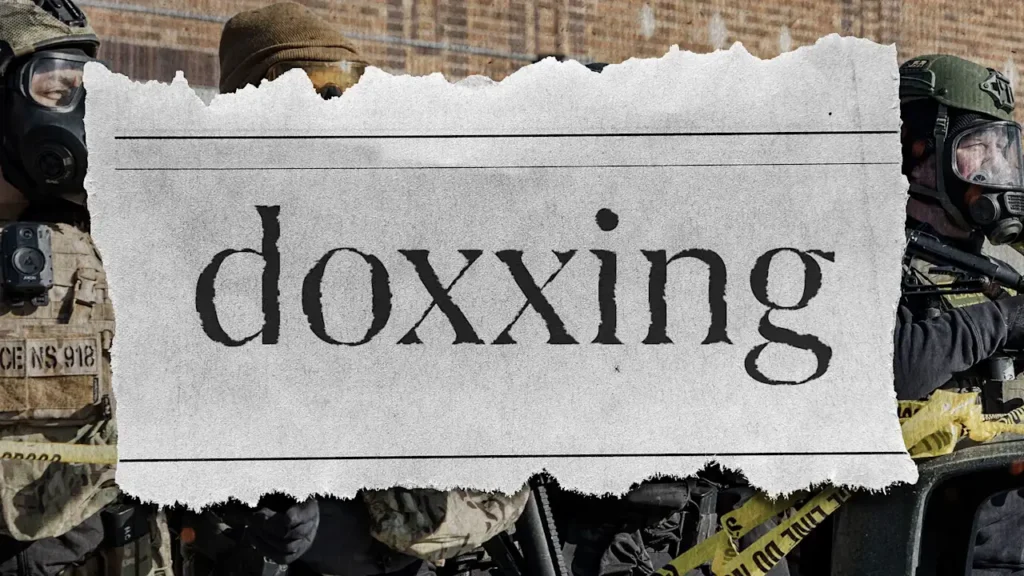
Concept creep is literally problematic. It’s what happens when words like “problematic” and “literally” expand far beyond their original definitions, eventually becoming so diffuse as to no longer hold any real meaning.
The latest victim of concept creep is “doxx”—a word being stripped of its meaning amid debate whether federal agents should be allowed to shield their identities through masks and other means
As a refresher, to doxx someone is, definitionally, “to publicly identify or publish private information about [them], especially as a form of punishment or revenge.” The word arose from ‘90s hacker culture, to describe the digital unmasking of someone otherwise known only by a username by sharing their identity or personal information publicly. Although it remained in the fringe realm of 4chan message boards for ages, doxxing went mainstream in the 2010s, with the Gamergate fiasco. During that unfortunate episode, disgruntled video game fans embarked on an online harassment campaign against women and marginalized people, falsely framing their efforts as a push for “ethics in games journalism.” As part of the harassment, trolls surfaced private information—including home addresses and personal emails—of mostly women in gaming culture, whom they perceived as their enemies.
In the years since, the word has seemingly come to mean any form of nonconsensual disclosure whatsoever, regardless of what is being disclosed or its relevance to public interest. Perhaps unsurprisingly, the people most aggressively watering down what it means to doxx someone—members of the Trump administration and Republican party—are also the ones most apt to do it the good old-fashioned way to intimidate perceived political opponents
A loosening definition
Earlier this week, Senator Thom Tillis of North Carolina took liberty with the definition of doxxing during an appearance on CNN. Speaking with anchor Jake Tapper, the Senator explained that he opposed ICE agents being barred from wearing masks because, “I’ve seen people take pictures and identify law enforcement officers and then put their families at risk.”
Setting aside whatever Tillis thinks he means by having been doxxed himself, his definition for law enforcement officers is inaccurate. In order to meet the criteria for doxxing, merely identifying someone would only count if the person in question had no reason for their name to be publicly known. Federal agents, on the other hand, are public servants—traditionally identifiable by badges, something ICE agents tend not to wear. Revealing their names in a context related to public enforcement is not doxxing; it’s just normal transparency. (The kind of thing one might think the self-proclaimed most transparent administration in history would believe in.)
Under some state laws, including in Minnesota, the identity of undercover agents can be legally withheld to protect their safety and the effectiveness of an investigation. There’s a difference, though, between an undercover agent and one who would just prefer to not be identified. In any case, when any agent is involved in a shooting, no umbrella federal statute exists prohibiting them from being identified. In fact, the public-records laws of many states require disclosing the names of officers involved in shootings upon request, barring any specific legal exemption.
Department of Homeland Security secretary Kristi Noem seems to believe otherwise. Under her leadership, the names of the agents who shot Alex Pretti last weekend are being kept secret. That’s in-line with her Jan. 18 appearance on Face the Nation, when she said “we shouldn’t have people continue to dox” Jonathan Ross, the ICE agent who shot Renee Good—by saying his name, which was by then a matter of public record.
Shifting the definition of doxxing fits well into the broader effort to shield ICE officers from accountability. Perhaps that’s why Rep. Andy Ogles of Tennessee sponsored the “Protecting Law Enforcement from Doxxing Act” last fall, which would criminalize publicly revealing federal officer names in order to obstruct an ICE investigation. (The bill currently remains in committee.)
Interestingly, for as much as Republicans officials are loath to put public servants’ families at risk by having their names amplified online, that concern only seems to flow in one direction.
Doxxer in chief?
As lawsuits challenge various aspects of president Donald Trump’s domestic policy agenda, he has increasingly found himself at odds with federal judges. Always happy to be the proverbial hit dog, whenever lower court judges have ruled against Trump in his second term, he has often raged about them by name on social media, to his millions of fired-up supporters. Either as a direct result, or perhaps just in an incredible series of coincidences, several judges reported subsequently experiencing intense harassment. According to an NBC News report, one of these judges had to move houses, another froze her credit cards after a security breach, and others still had to either upgrade their home security systems or change their daily routines.
Some forms of harassment have been more sinister than others. Dozens of judges have reportedly had unsolicited pizzas delivered to their homes—with the name on the order attributed to “Daniel Anderl,” the name of district judge Esther Salas’s 20-year old son, who was killed by a disturbed litigant posing as a deliveryman. The harassment campaign was so pronounced in the early months of Trump’s second term, Chief Justice John Roberts even criticized the “political attacks” prompting them—naturally without ever mentioning whose prominent Truth Social account was behind them.
Does merely mentioning these judges by name count as doxxing? When using a megaphone as singularly massive as the office of the presidency, it sure seems like it meets the definition of “publicly identifying someone as a form of punishment or revenge.” Whether it fits the bill as doxxing or not, though, Trump’s targeted rants have repeatedly inspired precisely the kind of dangerous conditions Republican officials claim ICE agents should be shielded from.
Despite an abundance of national news items about the harassment of judges who rule against Trump, no elected Republicans have rushed to protect these public servants in the same way. In fact, one such representative reportedly kept a “wanted” poster of judges who’d ruled against the president hanging outside his congressional office last year. That representative’s name? Andy Ogles of Tennessee—the same one who introduced the Protecting Law Enforcement from Doxxing Act last fall.
Hopefully, he won’t consider pointing out his hypocrisy in public the same thing as doxxing.