Just six months ago, most congressional Republicans kept their distance from Elon Musk after the tech mogul’s messy political breakup with President Donald Trump and his feverish attempt to kill their signature megabill.
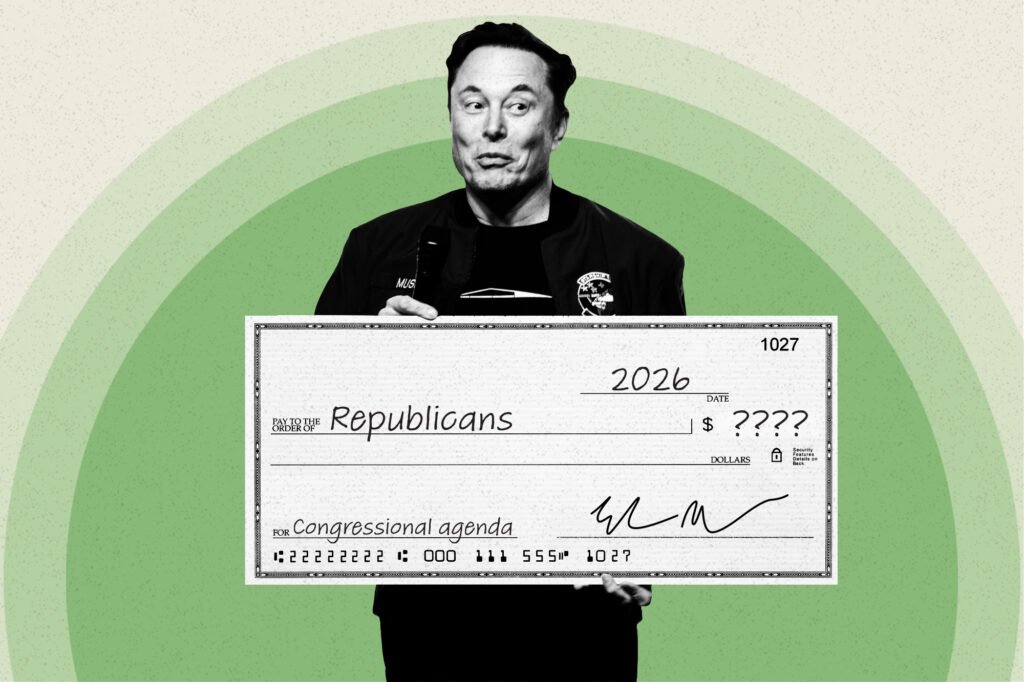
Musk is persona non grata no longer, thanks to his mega checkbook and mega platform — both of which he is now using to influence the future of the GOP.
Republicans see his recent donation to a Kentucky Senate candidate as an encouraging sign that Musk will make good on his promises to back the GOP, and top House leaders are elated — especially those in charge of defending their razor-thin majority. Musk spent more than $260 million in the last election helping to elect Trump and Republicans.
“It’s definitely a positive development for us,” NRCC Chair Richard Hudson said in an interview.
He added, “By the way, when they had their rift, I told you all this would happen.”
That rift seemed unlikely to heal early on, with Musk accusing the president of covering up the Jeffrey Epstein files because Trump was named in the documents, then threatening to start his own political party.
But just six months later, Musk is back having dinners with Trump and attempting to steer GOP policy again — and he is making his presence felt in key offices on Capitol Hill.
Musk, who posted on New Year’s Day that “America is toast if the radical left wins,” did not respond to requests for comment.
Recently he has used his 233-million-follower X account to push Senate Republicans to pass the SAVE Act — a bill meant to tighten election laws to prevent noncitizens from voting, in part by imposing new proof-of-citizenship requirements and restricting mail voting.
The campaign has driven a huge volume of calls to member offices, according to two aides granted anonymity to discuss internal matters, forcing Republican after Republican to publicly state their support for the legislation. It has no Democratic support and has not been called up for a vote because it cannot overcome the Senate’s 60-vote filibuster hurdle.
Two of the Senate’s most endangered Republican incumbents — Sens. Bill Cassidy and John Cornyn — have leaned into Musk’s push to hold a vote on the bill, often reposting his messages on their accounts. Cornyn also spoke privately with Thune about the bill last week.
When Sen. John Boozman of Arkansas announced on X Saturday he was “reviewing” the bill, Musk reposted the message with a pair of American flag emojis.
Asked about the bill, Senate Majority Leader John Thune said in an interview Tuesday night that he was sure it would come up for a vote “at some point” but “we’ll have to figure out where we can get it done.”
“We’ve got a lot of interest in it, and I’m supportive of it,” Thune said, noting he has co-sponsored the bill previously.
The public pressure campaign appears to have caught some Republicans by surprise given that there’s been little internal rush to formally sign onto the bill since it’s currently not moving and can’t pass the Senate.
Congressional Republicans, who have fresh memories of the trail of destruction he has often left on Capitol Hill, see Musk’s re-emergence as a mixed blessing. He blew up a carefully negotiated bipartisan government funding deal in December 2024 and almost sunk the GOP megabill in the final stages of passage over his personal objections to the cancellation of electric vehicle subsidies and other policies.
“He’s a big voice,” said Rep. Blake Moore (R-Utah), a member of House GOP leadership, who recalled how Musk was “really antagonistic” about the huge Republican policy bill last year.
But, he added, “I think if he’s willing to be accurate, yeah, then I then totally want him on board.”
That’s especially true when it comes to Musk’s money. Even amid his feuding with Trump, he cut $10 million worth of checks to the GOP super PACs charged with preserving the House and Senate majorities.
But with Musk dropping another $10 million into Kentucky Senate candidate Nate Morris’ campaign effort — and ending his dalliance with a third party — the expectation is that more checks will now be on the way.
Hudson said he hasn’t talked to Musk yet about any future financial commitments to helping House Republicans. But members are straining to get in his good graces as Republicans face huge midterm challenges without Trump on the ballot.
“History is not on our side,” Rep. Carlos Gimenez (R-Fla.) said, referring to the typical midterm losses suffered by the president’s party. “We’ll take any and all help possible to reverse that trend in history, because I think it’s important for the Republican Party.”
Whether they want Musk as a presence on the campaign trail is a more complicated question. His Department of Government Efficiency initiative is widely seen as a bust nearly a year later, and his post-2024 election efforts to vocally back conservatives — like a Wisconsin Supreme Court candidate — backfired at the ballot box.
Rep. Ralph Norman (R-S.C.), a hard-liner who is running for governor of South Carolina, said Musk “did an unbelievable job in identifying waste, fraud and abuse” and would be welcome both on the campaign trail and in his potential administration as an efficiency consultant.
But Republicans in swingier territory are cooler to the idea of a large Musk presence in their races this fall.
Rep. Rob Bresnahan (R-Pa.), one of the most vulnerable Republicans in the House, said he was pleased to see Trump and Musk patch up their rift — that “obviously we are better when we are united and as a team.”
Asked if he wanted Musk to campaign in his district, Bresnahan was more equivocal.
“I’m not really sure — I’m impartial,” Bresnahan said. “We look at whoever’s going to be supportive of what we’re trying to do for northeastern Pennsylvania, and if their mission aligns with our mission, then we’re going to embrace it.”