On January 22, artist Gabrielle Goliath and curator Ingrid Masondo filed a founding affidavit in the High Court of South Africa in Pretoria, stating their intention to challenge South African Minister of Sport, Arts and Culture Gayton McKenzie’s unilateral decision to terminate the video and performance series, Elegy, at its national pavilion at the 2026 Venice Biennale. McKenzie had attempted to characterize Goliath’s piece, which would have centered Palestinians enduring genocide in Gaza, as “highly divisive” and not aligned with South Africa’s interests — even though the country famously brought a legal case against Israel at the International Court of Justice (ICJ) in The Hague over allegations of genocide in Gaza.
Reviewed by Hyperallergic, the affidavit requests that the Minister’s “interference with and obstruction of the implementation of the decision” be “set aside,” as it “is unconstitutional, unlawful and invalid.” Notably, a central figure in the legal team representing Goliath and Masondo is Adila Hassim, a member of the legal team that brought South Africa’s case to the ICJ.
The concentrated attempts to prevent Goliath’s work from reaching a global platform are not the result of incompetence or poor strategizing. Rather, what the multiple press releases, semi-artful attempts at cover-up, and contradictory statements reveal is this: The machinations and borders of neo-imperial, genocidal states are made malleable for the purposes of silencing dissent. As scholars Christina Sharpe and Rinaldo Walcott recently wrote in Hyperallergic, “Genocide wants no witness. Genocide wants to elude the name.”
McKenzie’s heavy-handed interference in the process of selecting the artist and project for the Venice Biennale were first made public soon after he reportedly “fired off a letter to Art Periodic” — a nonprofit entity appointed to organize fundraising and other logistical matters for the South African pavilion — stating that he opposed the decision to select a work that, in part, commemorates the lives of those killed in the genocide in Gaza.
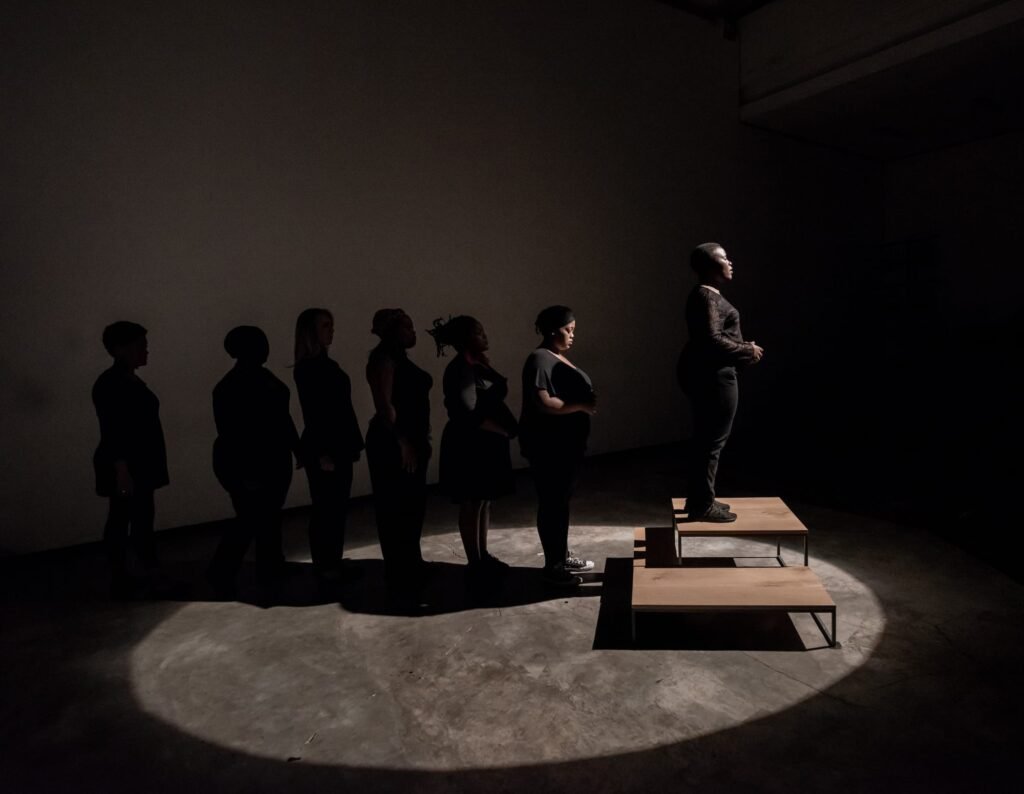
Goliath has described Elegy as an ongoing project of “mourning and repair,” with each iteration commemorating the lives of women and LGBTQ+ people killed because of their gender identity or sexual orientation. The variation conceptualized for the Venice Biennale consists of three parts. The first section focuses on the ongoing crisis of gender-based violence, LGBTQ+ killings, and femicide in South Africa; the second, on the genocide of Ovaherero and Nama people in Namibia by German forces during the early 1900s, now regarded as the first recorded genocide in modern history. It was the third section — which includes a commemorative poem dedicated to the Palestinian poet Hiba Abu Nada, who was killed along with her son by an Israeli airstrike in October 2023 — that appeared to have raised the minister’s ire.
Reportedly decrying Elegy as “highly divisive in nature” because it “relates to an ongoing international conflict that is widely polarizing” in his letter to Art Periodic, McKenzie threatened to withdraw financial support for the project unless changes were made. His requirements included the removal of the section that addresses Gaza, according to the Daily Maverick.
Following a statement from the official selection committee tasked with independently selecting an artist to represent South Africa at Venice, and press coverage detailing McKenzie’s interference, his subsequent public explanations differed from what he reportedly expressed in his communications with Art Periodic.
In a public statement issued on 10 January under government letterhead, McKenzie claimed that he had opposed the selection of Goliath’s work only because “it was brought to my attention that a foreign country had allegedly undertook to fund South Africa’s exhibition.” He did not specify which foreign nation. Moreover, he added, learning that “this foreign country had actually undertaken to purchase the artworks concerned following the conclusion of the Biennale” raised further “alarm, as it was being alleged that South Africa’s platform was being used as a proxy by a foreign power to endorse a geopolitical message about the actions of Israel in Gaza.”
McKenzie continued to insist that this was an instance of “foreign capture,” in spite of the fact that funds for pavilions often come from private donors and institutions. It was reported that the Qatar Museum cluster had expressed interest in funding the pavilion and possibly acquiring works in November, but it did not move forward with the funding after initial talks.
McKenzie’s colorful allegations of the “foreign capture” of the artist — supposedly to instrumentalize her for another state’s nefarious aims — were so bizarre that they only ended up fueling speculation about the possibility that he was the one being influenced by a foreign entity’s interests. In any case, his accusations left many in the South African art sphere unconvinced. Goliath told the Daily Maverick that she had been “independently developing and conceptualising” Elegy for years, long before it was considered for the Venice Biennale pavilion. In addition, private institutions, foreign or local, often fund pavilions at international art exhibitions and subsequently express interest in acquiring the artworks.
Perhaps anticipating the maelstrom to come, McKenzie added toward the end of his statement that the “South African government has an official position on Gaza, and I have always been careful to keep my personal political views out of my job as a Minister.” He asserted that he does “not use the Ministry in a manner that runs counter to the position of the state.” He was correct in foreseeing that this decision, one of a string of seemingly haphazard decisions indicative of crony capitalism, would have far greater consequences than he was accustomed to. The day after the release of his statement, the Democratic Alliance — an opposition party that more recently claimed a neutral stance but has historically supported Israel and initially criticized the African National Congress-led South African government’s decision to take Israel to the ICJ — declared that it “condemn[ed] Minister Gayton McKenzie’s decision to overturn South Africa’s official Venice Biennale submission after a lawful, independent selection process had already been concluded.” The party added that it would report him “to the Public Protector for acting beyond his lawful authority and undermining due process.”
The political-expediency hunger games were on.
Adding to the intrigue was an equally surprising announcement by Goodman Gallery in South Africa, which, after representing Goliath for a decade, dropped her soon after the announcement of her selection as the sole representative for the Venice Biennale pavilion was made public in December 2025. Speculation abounded within art world circles about a possible alleged connection between McKenzie’s interference and Goodman Gallery’s decision to drop a globally recognized artist. As McKenzie’s antics brought more attention to the gallery, it issued a press release on January 15, stating that it ended its relationship with Goliath as part of a “difficult commercial decision to slim down our roster of artists from over 50 to 40, alongside reducing our participation in international art fairs and cutting operational costs related to insurance, shipping, and art storage.” The statement denied that the gallery had “any contact with the Minister nor the Department of Sport, Arts and Culture” or were “directly involved with the South African Pavilion at the 2026 Venice Biennale at any stage.”
However, dropping a Venice Biennale artist seems contrary to what would usually guide a prudent business decision, especially given Goodman Gallery’s reputation for smart strategizing and longevity. Goliath is already a globally recognized and critically acclaimed artist. Her work has been acquired by museums and private collectors and was simultaneously shown at the Museum of Modern Art and MoMA PS1 in New York (the former closed this month, and the latter is up through March 16). Moreover, Goodman Gallery’s own New York outpost exhibited a solo show of her work, which closed on December 19. As the sole artist chosen to represent her country at the Venice Biennale, she was poised to bring even more prestige to the gallery. After the Daily Maverick broke the story of McKenzie’s cancellation of Elegy on January 9, several Israeli news outlets escalated the rhetoric, publishing alarmist claims about Goliath’s work. One stated that it “promote[s] a message about the October 7 war rather than about South Africa”; another claimed, “Qatar sought to covertly shape its pavilion at a prestigious Italian exhibition to advance Gaza genocide claims against Israel.” A third publication reported that “David Saranga, head of the Digital Diplomacy Division at Israel’s Foreign Ministry, said that the case ‘best illustrates how influence operations against Israel are carried out in the cultural sphere by states with significant resources.’”
Like many stories of powerful government officials who make decisions that seem inexplicably at odds with reason, McKenzie’s explanations have given rise to accusations of incompetence. His decisions, public announcements, and backtracking may appear, at first, to be haphazard. Illogical. Buffoonish, even. As Sharpe and Walcott asked, why would a minister representing the “same government that has held Israel accountable for its genocide in Gaza” decide to axe an artwork selected to represent the country on a global stage, breaking with his own government’s “official policy on the Israeli genocide of Palestinians”? Had he — as one of the two founders of the right-wing opposition party Patriotic Alliance, as well as a convicted armed robber and gang member who once served time for serious crimes — “gone rogue”?
Given the mess McKenzie created, it is inevitable that a public looking for reasonable explanations would frame him as incompetent or unable to act in a manner befitting a minister representing his country. But any time we see a cascade of statements, efforts to hide behind plausible deniability, and defensive counterclaims, ineptitude may not be the reason. It signals, instead, an attempt to conceal through strategic obfuscation. The whole circus McKenzie is at the forefront of orchestrating would not be happening unless very real power structures are being threatened.
What we are now witnessing — the levels of subterfuge involved in attempts to sabotage an artist and their work — hints at the expansive nature of contemporary warfare. Even though borders are increasingly framed as impermeable barriers, they are made “leaky” for the purposes of carrying out violent acquisitions of land and resources. Borders may be made conveniently permeable if and when a powerful state wishes to suppress dissent and prevent unfavorable critiques.
The attempts to quash Goliath’s work from being exhibited on a platform as significant as the Venice Biennale illustrate that conscientious artists will find themselves at the coalface of political dissent. They are often subjected to covert methodologies used to censor opposing views. Governments, corporations, and museum donors know that pulling financial and structural support for artists’ work can effectively thwart their autonomy and ability to speak critically. For these reasons, it seems possible that certain entities may be making concentrated efforts to prevent Goliath’s work from being realized. Stopping Goliath’s work from reaching Venice is evidently urgent enough to contradict the official political stance of South Africa — a nation whose representatives famously stood up in an international court to attempt to prevent the escalation of an ongoing genocide.
What exactly triggered the cascade of decisions that led McKenzie to block Elegy from reaching a global platform is not yet clear. Whatever the case may be, those involved in attempting to censor Goliath’s work underestimated the public’s response and the amount of respect that she has already garnered, in South Africa and around the world. Perhaps they did not anticipate that she and her team would fight back.
That so much effort seems to gone into censoring an artwork that commemorates and mourns the victims of an ongoing genocide — not one in some distant past — also speaks to the power and effectiveness of Goliath’s work. Without even reaching the intended platform, Elegy is already revealing the ways in which gender-based, genocidal violence attempts to silence.
Goliath’s work still has a chance to resonate with and amplify South African President Cyril Ramaphosa’s mission to eradicate the epidemic of gender-based violence in the country. Her artwork — like none other — represents South Africa’s support of the people of Gaza, and Palestine as a whole.
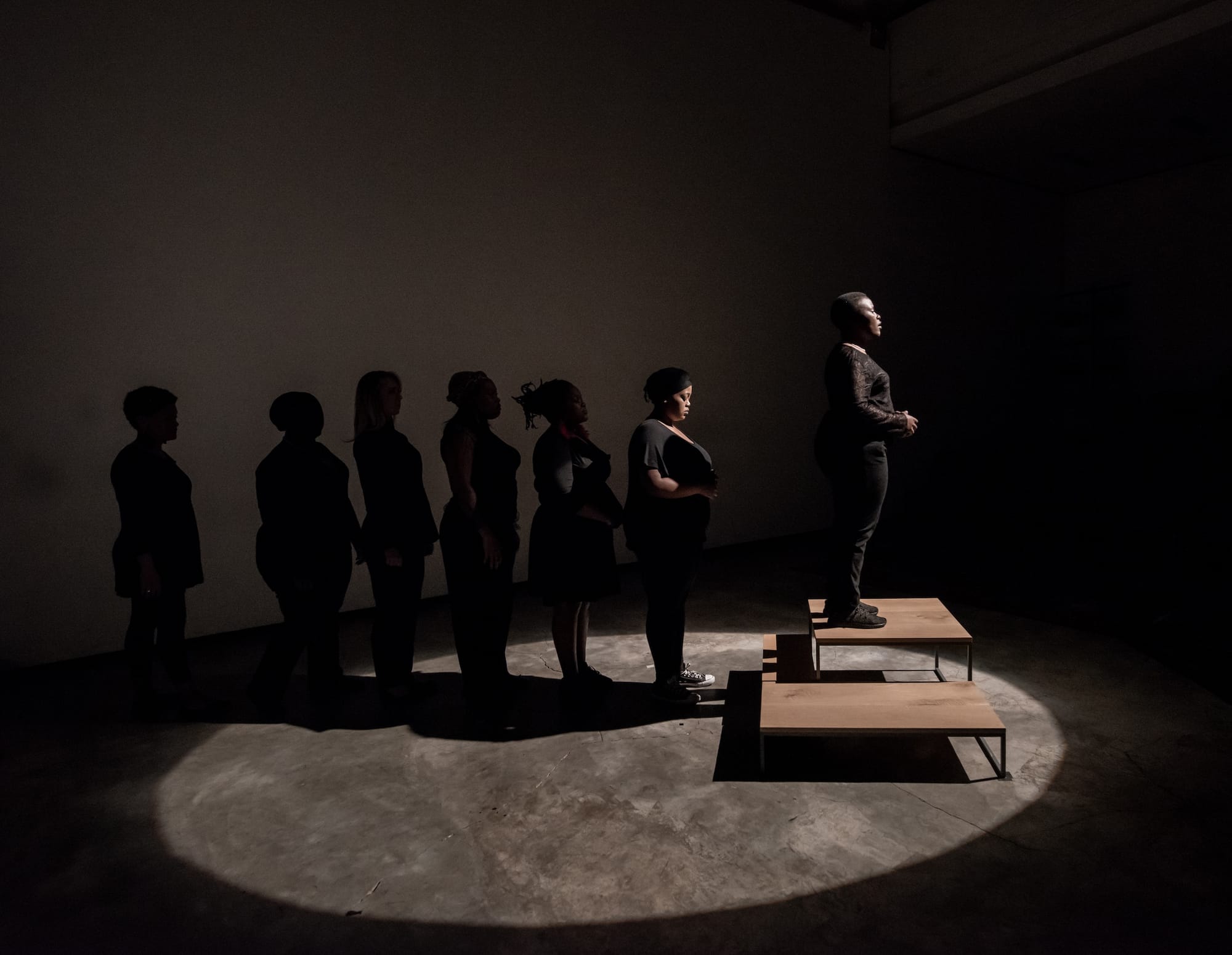
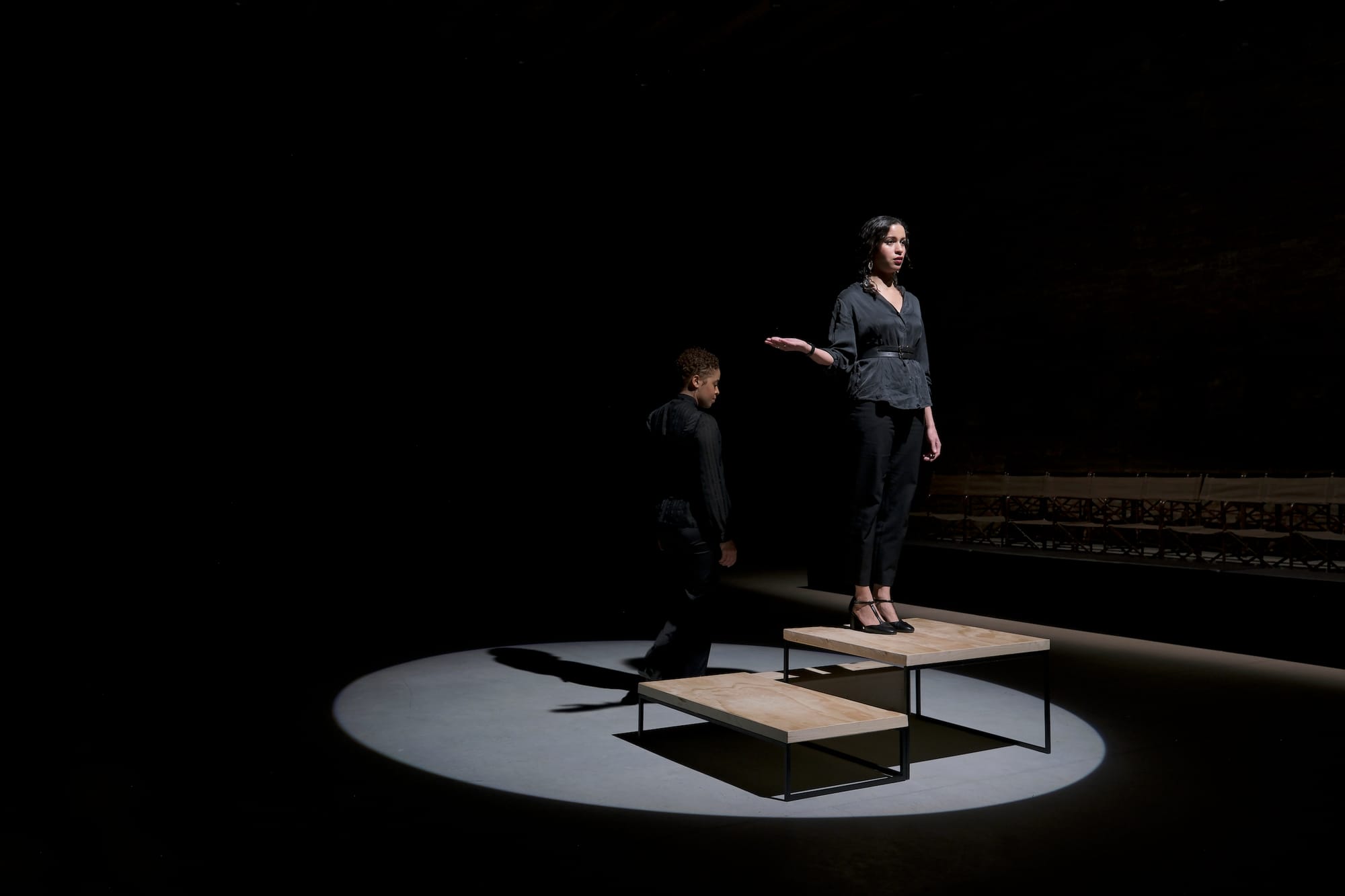
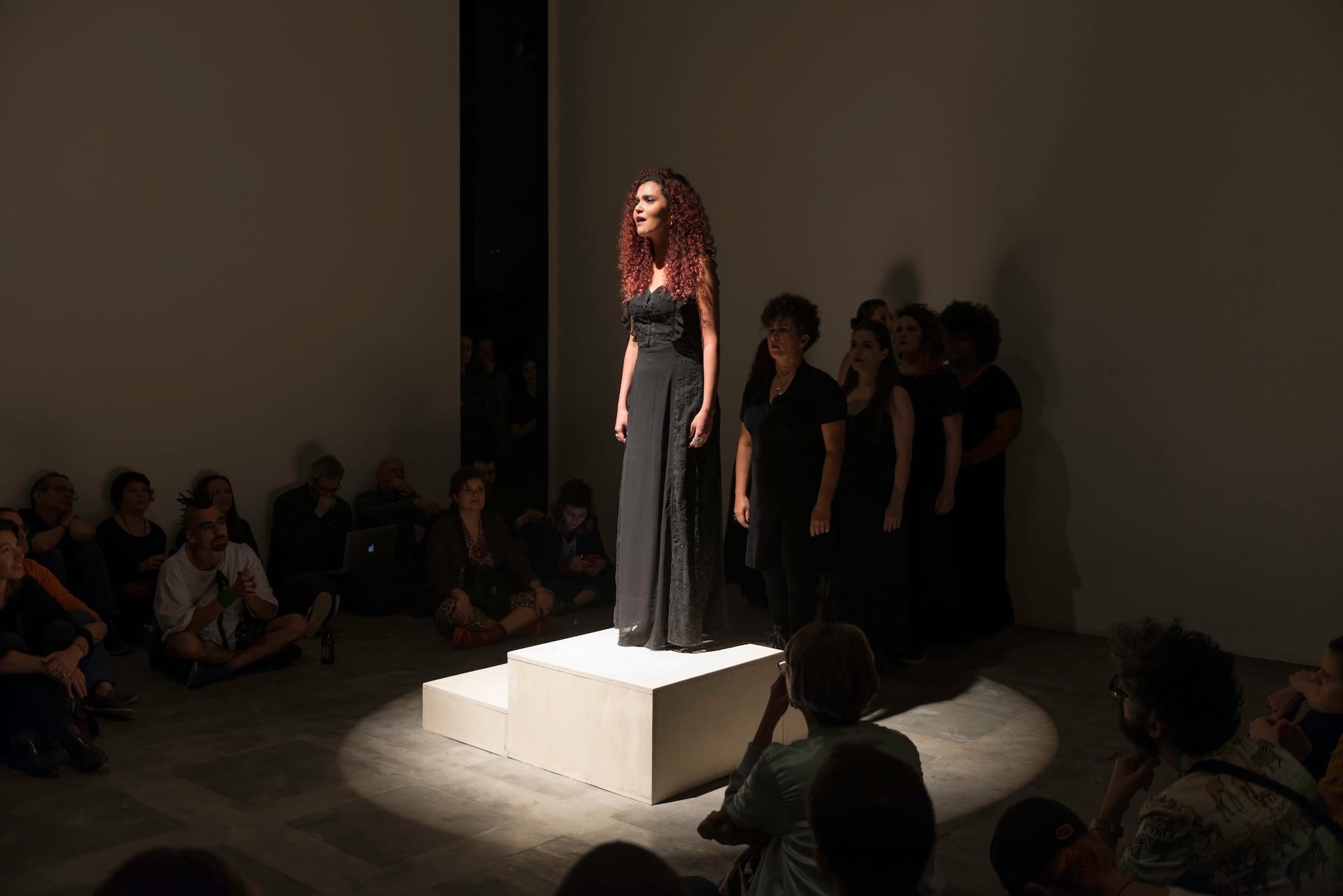
During the hour-long performances that comprise Elegy, operatically trained singers step up to a podium, one at a time, and sound a single note, which ebbs and rises with the tessitura and timbre of their voice. As their breath abates, they step down and exit to the right. Another performer steps up, and sounds out the same note. Their shared note rings purely — and for about the same amount of time — as a struck tuning fork. This is collective work, durational work. In the same way, we must take up the responsibility to prepare our voices for a time when our fellow witnesses’ voices falter, or are silenced.