
Huawei’s latest flagship foldable, the Mate X7, is finally here. It comes almost exactly a year after the Mate X6 was announced, and it’s a beast in a lot of areas. Unfortunately, due to the US ban on Huawei, they’ve fallen behind with their chipsets (since they aren’t able to work with ARM due to this ban). But other than that, this foldable is perhaps the best foldable on the market right now.
Let’s dive into the full review of the Huawei Mate X7.

The Mate X7 has arrived, and Huawei isn’t pulling any punches with its gorgeous displays, industry-first water resistance, and a camera that might just be the best on any foldable right now.
Pros
- Best-in-class camera system with variable aperture and largest sensor on a foldable
- Industry-first IP58/IP59 water resistance rating
- Gorgeous OLED displays with minimal crease visibility
- Strong battery life approaching 20 hours
- Fast 66W charging
- High-quality case included in the box
Cons
- Severely underpowered 6nm processor benchmarks near budget phones
- Runs Android 12-based EMUI 15, which is five years outdated
- No Google services without workarounds
- No promised software update timeline
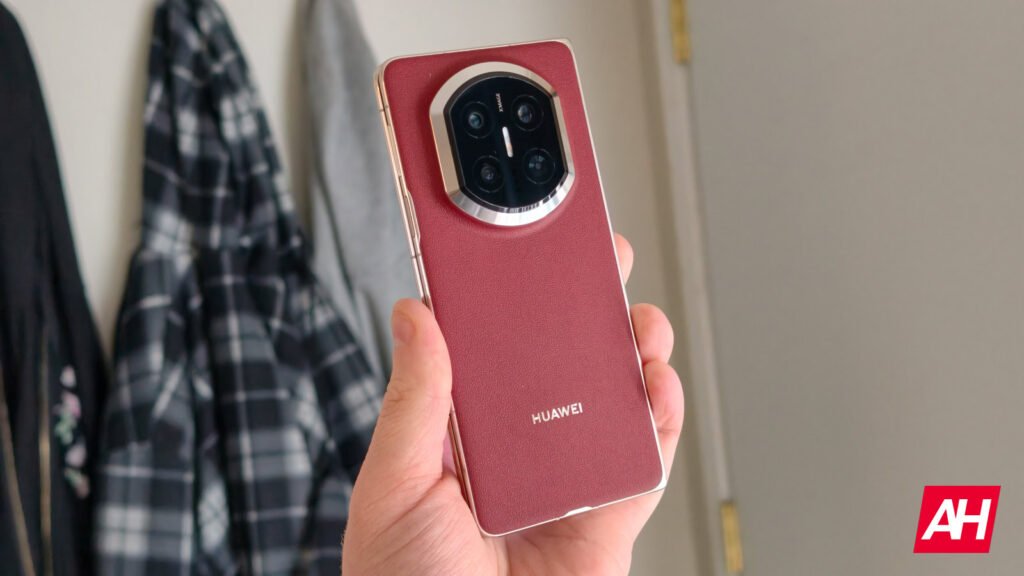
Huawei did send us the Mate X7 in the Nebula Red color to review. This is not a sponsored review and Huawei did not see this review before it was published.
Huawei Mate X7 Specs
Huawei Mate X7 Specs
| Displays | 8″ Inner display, 120Hz; 6.49″ Cover Display ,120Hz |
| Processor | Huawei Kirin 9030 Pro (5nm) |
| RAM and Storage | 12GB/256GB; 12GB/512GB; 16GB/512GB; 16GB/1TB; 20GB/1TB |
| Cameras | 50MP primary 1/1.28 f/1.5-4.0; 50MP Ultrawide f/2.2; 50MP 3.5x Periscope Telephoto f/2.2 |
| Battery | 5,600mAh |
| Charging | 66W Wired, 50W wireless, 7.5W reverse wireless, 5W reverse wired |
| Colors | Black, Brocade White, Nebula Red, Purple, Blue |
Huawei Mate X7 Review: Design and Build Quality
Huawei continues to make top-notch hardware; the Mate X7 is a very solid-feeling foldable from the company. It looks great with the centered, round camera module, the rounded edges making it easy to hold onto and open up, and of course, it comes in a really cool Nebula Red (as well as Brocade White and Black). Which makes it look quite stunning.
The biggest design change from its predecessor is actually the camera design. It now has the “Time-Space Gate” design as Huawei calls it, which does look quite cool. While the Mate X6 was a bit more rounded. Otherwise, the design is virtually identical between the Mate X6 and Mate X7, which is perfectly fine because Huawei does make some beautiful hardware.
The Mate X7 is also fairly thin, though not quite as thin as other foldables from last year like the OPPO Find N5 and Samsung Galaxy Z Fold 7. Both of those devices are 4.2mm unfolded and 8.9mm folded, while the Mate X7 is 4.5mm unfolded and 9.5mm when folded. To be honest, I only notice the thickness on the Mate X7 because the edges are rounded. If they were flat like Samsung and OPPO, it would feel even thinner than they are. But because they are rounded, it feels much thicker than 0.3mm unfolded. But on the plus side, these rounded edges means its easier to open when folded.


Another tick for Huawei’s spec sheet is the water and dust resistance. It’s IP58/IP59 rated, which is a first for a foldable. Most foldables are IP48, while Google’s Pixel 10 Pro Fold is IP68, none of them have hit that 9 for water resistance, which means it can handle high-pressure water jets.
Finally, let’s talk about one other aspect of this phone that I think a lot of people are going to miss. And that’s the vegan leather back. Unfortunately, this is only on the Black and the Nebula Red colors that I have here. The white color, as usual, is more of a slippery material. Though I can’t say how slippery since I don’t have it here to test. But this vegan leather not only looks good, it feels good too. And it also helps with grip, so you’re less likely to drop it.
Huawei also included a very nice case in the box, which is vegan leather with a rotating kickstand that looks amazing. It might be my favorite foldable case so far, but that is admittedly a low bar.
Huawei Mate X7 Review: Display
Both of the displays on the Mate X7 look incredible. The outer display is a 6.49-inch LTPO OLED panel with 3,000nits of peak brightness. While the inner display is a 8-inch Foldable LTPO OLED panel with 2,500nits of peak brightness. And it looks absolutely incredible. I’ve thoroughly enjoyed watching content on both of these displays, as the colors look very accurate, and even at max brightness the colors don’t take a hit. Of course, as is the case with a lot of smartphones, you can adjust the screen colors as well.
By default, the display defaults to “normal” mode for colors, but there is a “Vivid” option, which is what I preferred to use. On top of that, you can also change up the color mode from Default, to Warm to Cool, and even drag the selector across the color map to get the perfect color temperature.

Now what about that crease? I feel like with every foldable I’ve reviewed, I’ve said that you can barely see it now, and that’s still true with Huawei’s Mate X7. I’d say it’s even less visible than the OPPO Find N5 and the Galaxy Z Fold 7. In fact, you’ll see it more than you’ll feel it. But most of the time, I’ve totally forgotten that it was even there.
To be honest, despite the fact that Huawei can’t work with a lot of partners now, since the US put them on their Entity List, the company is still churning out some really good displays on its devices.
Huawei Mate X7 Review: Performance
Now this is where things start to turn for Huawei on the Mate X7. As much as we all love Huawei as a company and love their products, there’s no way for us to sugarcoat the performance on the Mate X7. It’s not good. Not even close to good. We’ll talk about the benchmarks in a little bit, but you have to remember that this is a 6nm processor in the Kirin 9030 Pro. Compared to 3nm processors from MediaTek and Qualcomm in their competitors.
The Kirin 9030 Pro is a 9-core chipset that runs at a max of 2.75GHz. Compared to the Snapdragon 8 Elite Gen 5, which maxes out at 4.61GHz. So quite the difference there. Huawei didn’t skimp on RAM here, offering up 12GB or more across all of its options. Our model here is the middle-of-the-road option with 16GB of RAM and 512GB of storage.
And unfortunately, performance is not good. A lot of the time, we’ll see lower benchmark scores but not really notice how slow a phone is in day-to-day usage. That is not the case with the Mate X7. It’s so bad, in fact, that I’m not sure I can recommend this at its European price of €2,099 (That’s almost $2,500 USD, almost the rumored price of the Galaxy Z TriFold).
While benchmark scores are in-line with $200 smartphones, I will say day-to-day usage does not feel that slow. Apps are still slow to open, sometimes touches are slow to actually register, even the fingerprint sensor can be a bit on the slow side. But not nearly as bad as the benchmarks would suggest.
Benchmarks
For every phone that we review, we run a series of benchmarks, to see how well the performance actually stacks up. The Huawei Mate X7 is a bit of an interesting one here, and will be compared with two other foldable devices from 2025, as well as the $199 Galaxy A17 that we just reviewed. And you’ll see why in a second.
| Device | Geekbench CPU Single-Core | Geekbench CPU Multi-Core | Geekbench GPU |
|---|---|---|---|
| Huawei Mate X7 | 1,107 | 4,913 | 6,136 |
| OPPO Find N5 | 2,916 | 8,138 | 17,861 |
| Samsung Galaxy Z Fold 7 | 3,009 | 9,385 | 18,294 |
| Samsung Galaxy A17 | 927 | 1,776 | 1,286 |
As you can see from the Geekbench results above, Huawei Mate X7 actually is more aligned with the Galaxy A17 scores, which is almost 10x cheaper than the Mate X7. We’re looking at over a 50% difference between the Mate X7 and the other foldables here, which explains why the phone’s performance is not that great.
| Device | AnTuTu Score |
|---|---|
| Huawei Mate X7 | 1,624,366 |
| OPPO Find N5 | 1,787,849 |
| Samsung Galaxy Z Fold 7 | 2,060,275 |
| Samsung Galaxy A17 | 610,377 |
Now, Huawei does start to pull away here when it comes to the AnTuTu score, which isn’t that surprising, because remember, this score tests everything. And that added RAM definitely helps the Mate X7 here. Still hard to justify the price to performance here on the Mate X7, unfortunately.
Thermals
Now let’s talk about thermals here. This is where we’ll really see how good that processor is, and Huawei’s cooling. Does Huawei aggressively throttle the CPU like a lot of other Chinese phones? Let’s find out.
There are three tests that we do for testing out thermals. We run the 3D Mark Wildlife Extreme Stress Test, which is designed to push your phone to its absolute limits. You’d never hit these temps under any other load. We also play Genshin Impact for an hour at max graphics and brightness. And our final test is 4K60 recording. We record the temperature at 5-minutes and again at 10 minutes. This gives us a good idea of how optimized it is in each of these processor-heavy scenarios. Typically, the camera and Genshin Impact temps are very similar, however.
Also important to note, we do not run these back to back to back. These are done on different days, with the temperature starting at the same temp, about 70 Fahrenheit, which is about room temperature. That way, these tests are fair.
| Device | 3D Mark Wildlife Extreme Stress Test | Genshin Impact | Camera – 5m | Camera – 10m |
|---|---|---|---|---|
| Huawei Mate X7 | 106.4 | 93.4 | 97.3 | 99.3 |
| OPPO Find N5 | 104.5 | 92.5 | 99.2 | 104.1 |
| Samsung Galaxy Z Fold 7 | 110.1 | 101.2 | 95.7 | 99.8 |
Huawei Mate X7 Review: Battery Life and Charging
Huawei managed to cram a pretty hefty battery into the Mate X7 this year. Of course, like most other Chinese OEMs, they are also using Silicon-Carbon for their batteries. Which allows for higher-density batteries at much smaller footprints. So despite this being just 4.5mm thick, you’re still getting a battery that is more than 12% larger than the Galaxy S25 Ultra.
In fact, it’s one of the largest in a foldable too. It’s the same size as the OPPO Find N5, and only the HONOR Magic V5 and vivo XFold 5 are larger at 5,820mAh and 6,000mAh, respectively.
But how does the battery life stack up? Well, for me and my usage, it does last a full day without any issues. It’s actually pretty similar to the Find N5 in terms of my usage. Now, because the Mate X7 doesn’t work all that well on US networks (you’ll get some 4G LTE and very little 5G coverage on T-Mobile) I couldn’t use this as my daily driver – nevermind the Google apps being a real pain to use. So I didn’t use it quite as much as some other foldables, but it does last quite a long time, which is great to see now on these newer foldables.
It does also charge very quickly. It comes with a 66W charger that is able to charge the Mate X7 in about an hour. And it is pretty quick to top off too, if you are a heavy user and need more juice in a short amount of time.
Benchmarks
When it comes to benchmarks for battery life, there are two tests that we run and we do run them back to back. First up is battery life. We set the display to about 150nits and turn off auto-brightness. Then start up a YouTube video and play the video until it dies. This is the same test we’ve run on over 100 different phones over the past few years. The Huawei Mate X7 performed quite well.
| Device | Battery Life | Charging Time |
|---|---|---|
| Huawei Mate X7 | 19 hours, 45 minutes | 44 minutes |
| OPPO Find N5 | 20 hours, 17 minutes | 50 minutes |
| Samusng Galaxy Z Fold 7 | 20 hours, 2 minutes | Samsung Galaxy Z Fold 7 |
And then once the phone runs out of juice, we plug it into either the charger that was included in the box, or one that can max out the charging speed. In this case, we used the 66W brick that comes with the Mate X7. As you can see, it actually charged faster than the Find N5 despite OPPO using a faster max charging speed.
Huawei Mate X7 Review: Software
The biggest headache with the Huawei Mate X7 is actually the software, which I really don’t like saying. But there’s no way around it. And I’m not just talking about the lack of Google services here. It’s a bit of a pain to get them installed, but it can be done.
No, the issue here is that the Mate X7 (at least the global version) is still running EMUI. It’s running on EMUI 15, which is based on Android 12. Just as a quick history lesson, Android 12 launched in late 2021. So we’re talking about a 5-year old version of Android here. It’s like stepping into a time machine, using a version of Huawei’s software that I was once very, very familiar with. Before the sanctions from President Trump, there were a few different Huawei (and HONOR) devices that I dailied for months.

Now, I’m not saying that this is bad software, it does absolutely fly on what is basically lower-end hardware, at least as far as the processor is concerned. But I think Huawei needs to bring HarmonyOS outside of China, instead of giving global users a much older version of Android.
Of course, as is the case with most of the skins coming out of China, it does look and act a whole lot like the iPhone. In fact, EMUI looks a lot more like Xiaomi’s HyperOS than it does HONOR’s current MagicOS that it uses on its phones.
The other thing here is that Huawei is not promising a certain number of updates like a lot of its competitors. Now this is could be due to the older processor technology, due to Huawei being worried about more US sanctions, or something else entirely. But where companies like Google, Samsung and now Motorola are promising 7 years of updates, it’s hard not to mention that aspect.
As far as the software experience goes, it’s pretty good. My biggest gripe is not having an app drawer, and there’s no way to enable it, surprisingly. Otherwise, the software is pretty good, especially for being on such an old version of Android.
Huawei Mate X7 Review: Camera
This is where the Huawei Mate X7 (and really all of Huawei’s most recent devices) shine. The camera. This is only the second Huawei phone I’ve used since they were put on the Entity list, and even before that I didn’t get to use very many after they teamed up with Leica – which ended in 2022.

I used the Pura 80 Ultra last year and absolutely loved it. I still sometimes use it for product photography, but I mostly use the vivo x300 Pro now. Let’s get back to the Mate X7 though. This has an incredible set of cameras.
| Camera | Specs |
|---|---|
| Primary | 50MP, f/1.5-4.0, 1/1.28″ |
| Telephoto | 50MP, 3.5x Optical Zoom, f/2.2 |
| Ultrawide | 40MP, f/2.2, 120˚ |
| Front-Facing | 8MP, f/2.2 (f/2.4 on cover display) |
So as you can see, Huawei did bring their variable aperture over to the Mate X7 too, which does make a huge difference. On paper, this is also the largest primary sensor on a foldable right now, with most others using a 1/1.56″ sensor. So this camera should take some really incredible shots right? Right. I’ve gotten some great shots out of this camera, though, with how cold its been lately, I haven’t been able to test it as much as I’d like.
Though, the minimum focusing distance on the primary sensor is quite far. Luckily, it does have a really good 3.5x sensor for macro shots that look absolutely incredible actually. It’s right on par with the vivo X300 Pro, but this is a foldable which makes it even more impressive.
You can see camera samples taken from the Mate X7 down below. These were all taken on the Mate X7 without any edits. Only resized to keep this page from loading so slowly.


This might be the best camera setup on a foldable right now. But, Huawei does have some stiff competition coming, including from its former sub-brand HONOR with its Magic V6 which will debut at MWC Barcelona in early March. OPPO is also planning to launch the Find N6 very soon, and their foldables have had great cameras, too. We could be approaching that time when foldables have virtually no drawbacks. Which is going to be absolutely incredible.
Should I buy the Huawei Mate X7?
This is a beautiful device from Huawei, which I’ve been saying for years. Huawei has never had issues with its hardware. They’ve always made well-built devices; their problem is the US. And because the US has blocked them from working with some key partners – like ARM – it makes the Huawei Mate X7 a hard sell.
I do love this device, but the lackluster performance and older software make me really question whether I should recommend this device. Seeing as this is a nearly $2,500 USD foldable, making it more expensive than the Galaxy Z Fold 7 and almost as much as the Samsung Galaxy Z TriFold. Ultimately, the decision is up to you anyway, but if you’re not a big Google user, then the Mate X7 might be the best foldable you can buy right now. But that won’t last long.

How does the Huawei Mate X7 stack up to the competition?
The main competitors for the Huawei Mate X7 right now are the HONOR Magic V5, OPPO Find N5, and the Samsung Galaxy Z Fold 7. All of which I believe are better options, purely looking at the performance. They are also cheaper, though the Magic V5 and Find N5 are harder to find, depending on where you live.
Let’s not forget about the new crop of foldables that are launching in the next month or so, too. Including the OPPO Find N6 and the HONOR Magic V6.
The post Huawei Mate X7 Review: The Toughest Foldable with the Best Camera appeared first on Android Headlines.