
Signal creator Moxie Marlinspike has launched a new open-source AI assistant called Confer. Like its messaging platform, this too has privacy at its core. What this means is that no one can read your conversations with Confer, not even server administrators, let alone hackers or law enforcement. Encryption is on by default, and data and conversations originating from users and the responses are encrypted in a “trusted execution environment (TEE)” that prevents anyone from accessing or tampering with them.
Conversations on Confer AI stay private
Signal uses encryption to make messages readable only to parties participating in a conversation. Confer AI protects user prompts, AI responses, and all data included in them. Much like Signal, it’s not possible to tie individual users to their real-world identity through email address, IP address, or other details. Confer AI will not use the data to train itself, nor will it sell the data to a third party. This is quite a bold move considering data is the value addition that keeps the AI chatbot free.
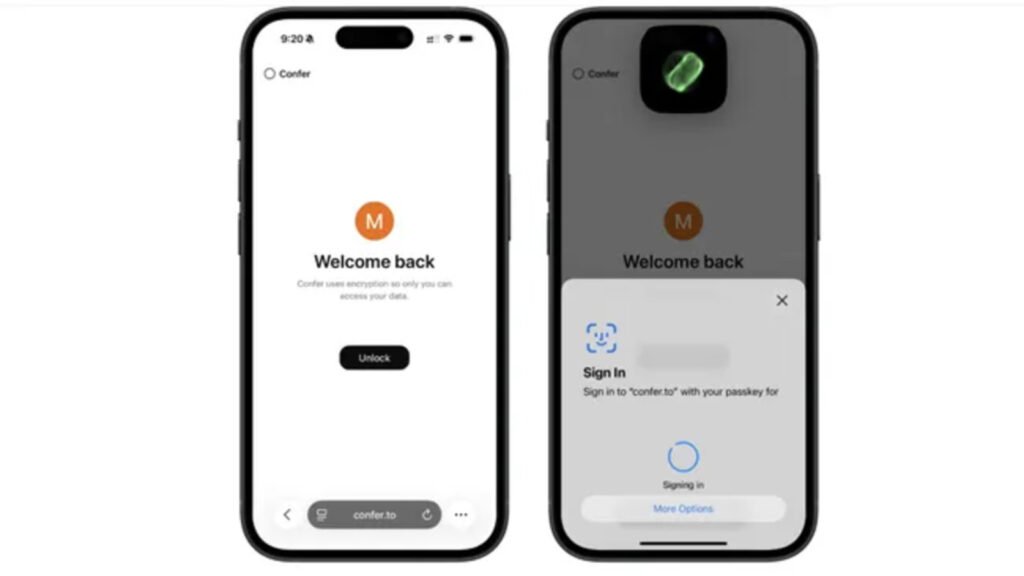
The company says that data encryption is on before it even reaches the server, using passkeys. The industry-wide standard generates a 32-byte encryption keypair that’s unique to each service a user logs into. The public key is sent to the server, while the private key is only on the user device, inside protected storage hardware that even hackers can’t access. Passkeys provide two-factor authentication, and you can configure them with a face scan, fingerprint, or a device unlock PIN or passcode.
Syncs chats between devices
Confer also supports syncing chats between devices the user owns. Thanks to cryptographic design, not even Confer’s creators can unlock them. Confer offers a remote attestation feature, which allows any user to verify exactly what code is running on Confer’s servers. The platform will also reportedly publish the software stack in full and digitally sign every release.
ChatGPT, Gemini, and Meta AI all offer opt-out toggles for options like chat history, allowing data for training, or outright removing data. But then these are on by default, and opting out is your responsibility. Confer is different, as it makes the most private setup the default.
Native support for Confer is available in the recent versions of macOS, iOS, and Android. However, on Windows, users must install a third-party authenticator. There’s no Linux support, but an extension bridges that gap.
The post Signal Creator’s New AI Assistant Won’t Read Your Chats—Not Even the Admins Can appeared first on Android Headlines.