The 2026 Mazda CX-5 arrives in the United States early next year. It will go up against the Toyota RAV4, which has also just entered a new generation. As if that’s not enough of a challenge, the CX-5 must also fill the big shoes of the second-generation model. But buyers are likely to move on to the new CX-5 quickly if it proves to be good, and Mazda has just given families a solid reason to spring for the new one, as it has passed its first major crash tests with flying colors. According to new Euro NCAP tests, the new CX-5 is officially a five-star car, and it achieved a particularly outstanding result for vulnerable road users.
Related: Your Next Car is About to Face Brutal New Safety Tests
No Safety Concerns For New CX-5
According to Euro NCAP (note that the new CX-5 is designated as a 2025 model in Europe, but will be a 2026 model in the USA), the Mazda CX-5 displayed zero major safety concerns in testing. It achieved the following results in four major safety-testing parameters:
- Adult occupant: 90%
- Child occupant: 89%
- Safety assist: 83%
- Vulnerable road users: 93%
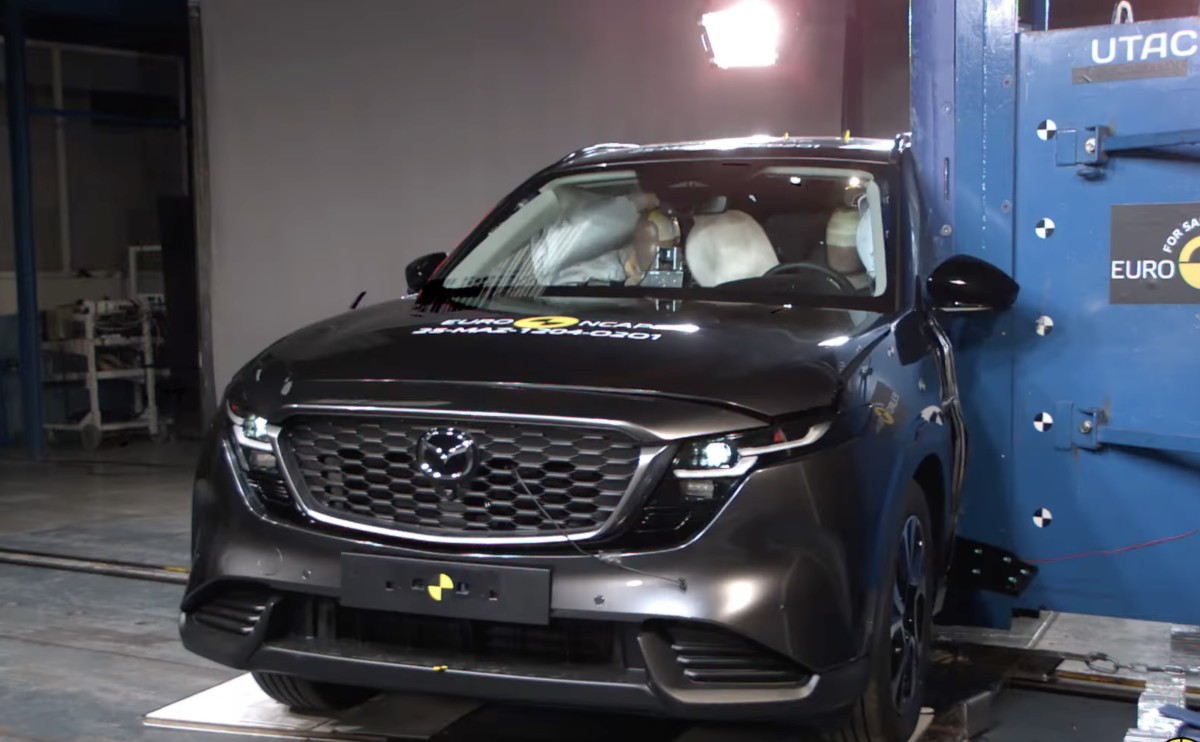
“The passenger compartment of the Mazda CX-5 remained stable in the frontal offset test,” said a report from Euro NCAP. “Dummy readings indicated good protection of the knees and femurs of both the driver and the front seat passenger. Mazda showed that a similar level of protection would be provided to occupants of different sizes and to those sitting in different positions.”
Euro NCAP/YouTube
The Mazda wasn’t perfect, though, with the safety authority noting protection of the driver’s chest as marginal, but it wasn’t enough to knock a star off its rating. The side barrier test returned adequate results, and the seats were able to reduce whiplash-related injuries. The fact that the Mazda protects occupants of different sizes is noteworthy, given that crash-test dummies have largely been designed around male body sizes for many years, but that’s finally changing.
The Mazda outperformed its rival, the Honda CR-V, in all four major categories, even when the Honda was equipped with the safety pack available in the European market. The CR-V performed well, but wasn’t as solid across the board as the Mazda.
The Mazda Stands Out In One Area
Euro NCAP/YouTube
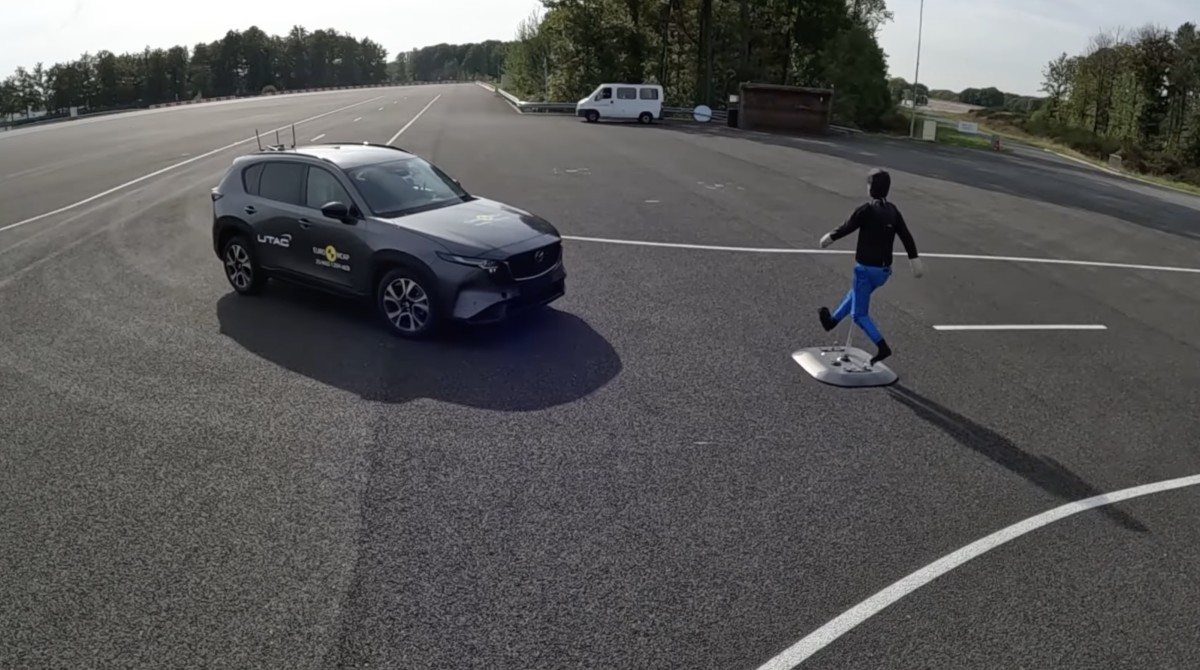
While occupant protection is generally a strong suit of modern vehicles in a crash, it’s more challenging to design a car that reduces the likelihood of injury or even death for vulnerable road users like pedestrians, cyclists, and motorcyclists. But the Mazda’s score of 93% in this area is outstanding. Protective measures for a vulnerable road user’s head were generally impressive, and the autonomous emergency braking system responded well to pedestrians and cyclists.
“In tests of its response to pedestrians, the system performed extremely well, including the protection it offered to those behind the car,” said the safety body.
To give you an idea of how good the Mazda’s 93% score is for vulnerable road users, here are a few recent vehicles and their comparable scores:
- Porsche Cayenne: 81%
- Hyundai Nexo: 76%
- Mitsubishi Eclipse Cross: 82%
- Jeep Compass: 74%
- Tesla Model Y: 86%
- Volvo EX90: 82%
- Volvo EX30: 79%
SUVs generally have a tougher time in these tests, as their taller, heavier bodies are riskier when accidents occur with pedestrians or cyclists.
Related: IIHS updates its testing criteria to focus on pedestrians and back-seaters
Final Thoughts
Many compact crossovers are used as family vehicles, so high safety scores in this segment are crucial. We expect to see similar results when local testing authorities (the IIHS and NHTSA) evaluate the CX-5 here.
What may count against the new CX-5 when it arrives is the lack of a hybrid. The RAV4 now has a standard hybrid that’s more powerful than the Mazda’s base engine. No turbocharged CX-5 has been announced, and although a hybrid is coming, that will only get here in 2027.