[Disclosure: AgFunderNews’ parent company AgFunder is an investor in Amatera]
Generating and screening new plant varieties takes time and money, claims Amatera, which reckons it can save significant amounts of both by high throughput screening of new varieties at the plant cell culture stage.
Cofounded in 2022 by Omar Dekkiche (CEO) and Lucie Kriegshauser, PhD (CTO), Amatera originally focused on developing new perennial crop varieties such as naturally caffeine-free coffee, Robustica coffee that tastes as good as Arabica, and mildew resistant grapes, by inducing spontaneous genetic variation using physical and chemical approaches.
This accelerated natural evolution process creates a massive library of non-GMO cell lines that it sequences and screens to identify those with desirable characteristics. The same high-throughput automated screening can also be applied to cell lines created via other methods such as gene editing. Promising candidates can then be regenerated into whole plants that can be tested in the nursery and the field.
“Today, the standard approach is to take these cells, first turn them into plants, and then do genotyping to see what you have,” Dekkiche tells AgFunderNews. “We are completely changing this by isolating all the cells, one from the other, to grow them in plant cell culture at a lab scale, and then we identify the cell lines of interest and only regenerate those into plants.
“This saves a ton of money and time. Instead of regenerating all the cells into plants and then screening the plants, we have removed the screening bottleneck.”
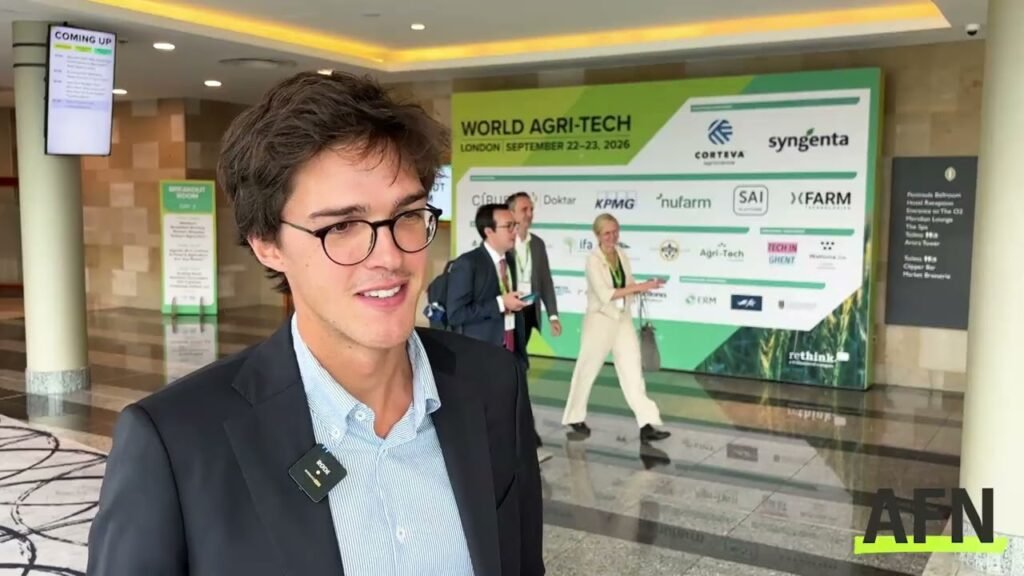
AgFunderNews (AFN) caught up with Dekkiche (OD) at the recent World Agri-Tech event in London to find out more.
AFN: What is Amatera doing differently?
OD: When you want to improve a plant, you have two families of approaches. You have conventional breeding where you take different parents, and you have biotechnology like gene editing.
In both cases, you have to screen a lot of plants to find the one that will have the good genetic markers from the parents or from your editing or your mutation. And this is a numbers game, so you need to screen hundreds or thousands or even tens of thousands of plants to find the ones that will matter and you want to carry forward for testing.
And this screening today is done on full plants where a lot of manual labor is spent to cultivate them, sometimes coming from cells so they spend time on tissue culture to get these plants growing before they are screened.
In our case, we want to screen at a cellular level as early as possible to avoid all the manual work and the time that has been spent on the ones that do not matter. That’s why screening as early as possible can save massive amounts of time and money.
AFN: Why doesn’t everybody screen at the cell stage?
OD: To screen at a cellular level, you need a lot of expertise in cell biology to be able to cultivate single cells to make them grow, and also you need to combine this with automation and robotics because it’s not possible to handle a single cell with a manual workforce.
We have developed a full pipeline of technology that we have patented that enables us to microculture single plant cells and cultivate them one from the other. So that’s the key.
AFN: Once you’ve done that high throughput screening at the cell stage, then you can identify the most promising candidates and only regenerate those into actual plants?
OD: Yes, we are currently creating data from real data from the lab on how much [time and money] we save [by using this approach], but we expect it will be at least five times the cost saving and two times the time saving [vs conventional methods].
AFN: A plant cell in a dish isn’t the same as a plant in the field, which might be interacting with soil and microbes and weather and all these other things. What traits can you reliably select for at the cellular stage?
OD: On a cellular level, we can screen for many traits, but we need to have a genetic marker. So we focus on the ones where we know we have to switch that gene to get a new function.
So those are the ones we are targeting today, but we see already potential for many more traits that even without a genetic marker, we want to be able to identify them at a cellular level, applying different screening methods. So that’s what we are developing.
AFN: I assume a trait like caffeine production is much more straightforward [to screen for in plant cell culture] than drought tolerance?
OD: Yes caffeine, for instance, is something that we can screen for in cells because [we can see that] the cells have the metabolism to produce caffeine.
But for drought or yield resistance, today we don’t have a clear screening that will enable us at a cellular level to do so [identify promising candidates], so we don’t promise that.
AFN: Can you tell me about the first crops that you are working on?
OD: We started on coffee and expanded to grapes a few years ago.
On coffee, we’re working on caffeine-free varieties and [a new variety dubbed] Robustica [that tastes like Arabica] to bring more robustness [resilience] to the coffee market. On grapes, we are producing wine grapes that are resistant to downy mildew and powdery mildew. So we’re mostly looking at resistance to fungus, which is the major problem at least in Europe for grape vines.
AFN: You’re developing a coffee variety that tastes like Arabica but has the resilience of Robusta. How much progress have you made?
OD: We have identified new genes that are involved in quality, so we are currently validating these new genes, so we are in the validation phase, and it will take some time before reaching the market. But we are progressing in that direction.
AFN: And what about the naturally caffeine-free coffee variety you’re working on?
OD: On caffeine, we are also progressing. There are some genes that are already known, but we have discovered new genes that will be more suitable for the variety we want to develop that will be caffeine-free.
AFN: You previously talked about moving into annual staple crops and partnering with seed companies?
OD: We have not yet announced any partnerships, but we are moving forward in that direction, and it will come in the coming months. So that for us is a big strategic angle.
AFN: You raised a seed round earlier this year that would help you “industrialize” your platform. What does that mean in practice?
OD: We are bringing together cell biology with robotics and machine learning and artificial intelligence. The industrialization is really to combine all of that in one end-to-end device that will be able to run workflow of plant cell regeneration autonomously.
So that’s what we mean by industrialization. It’s to make that technology real and we’re working on several crops. We are focusing on that with our seed round, and we also secured [a place on] the EIC accelerator [program in June] supported by the European Union to accelerate this industrialization.
Further reading:
🎥 ClimateCrop bets on starch ‘off switch’ to improve crop performance
OlsAro raises $5.5m seed round as salt-tolerant wheat nears market
Can Culta take Japan’s premium fruit model global?
The post 🎥 Amatera tackles plant breeding bottleneck with high-throughput cell screening platform appeared first on AgFunderNews.
