Editors’ Highlights are summaries of recent papers by AGU’s journal editors.
Source: Journal of Geophysical Research: Solid Earth
Reconstructing the direction and rate of motion of tectonic plates is essential for understanding deformation within and between plates and for evaluating the geodynamical drivers of plate tectonics. One debate concerns the relative importance of flow in the asthenosphere versus processes at plate boundaries in controlling the motion of tectonic plates.
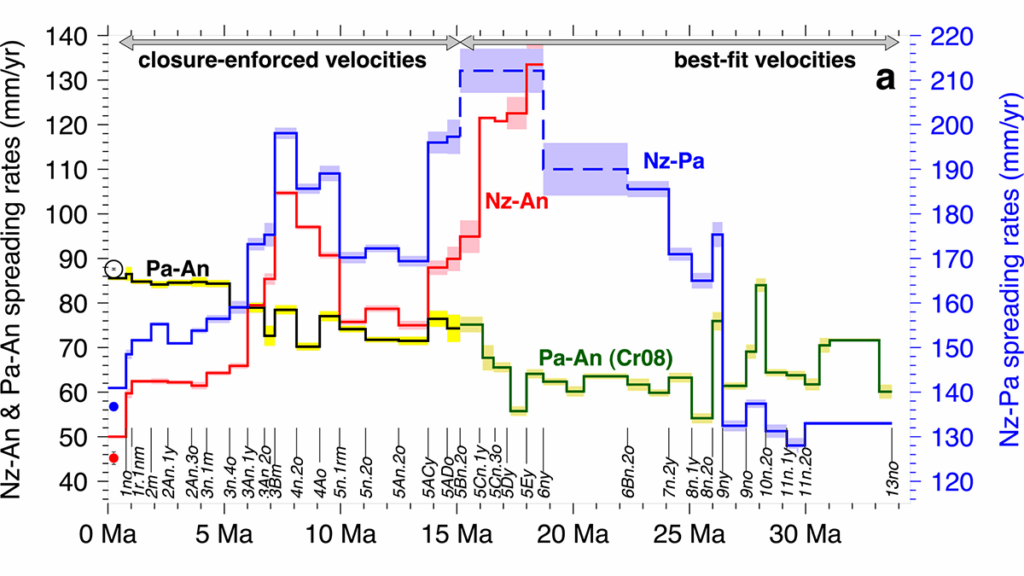
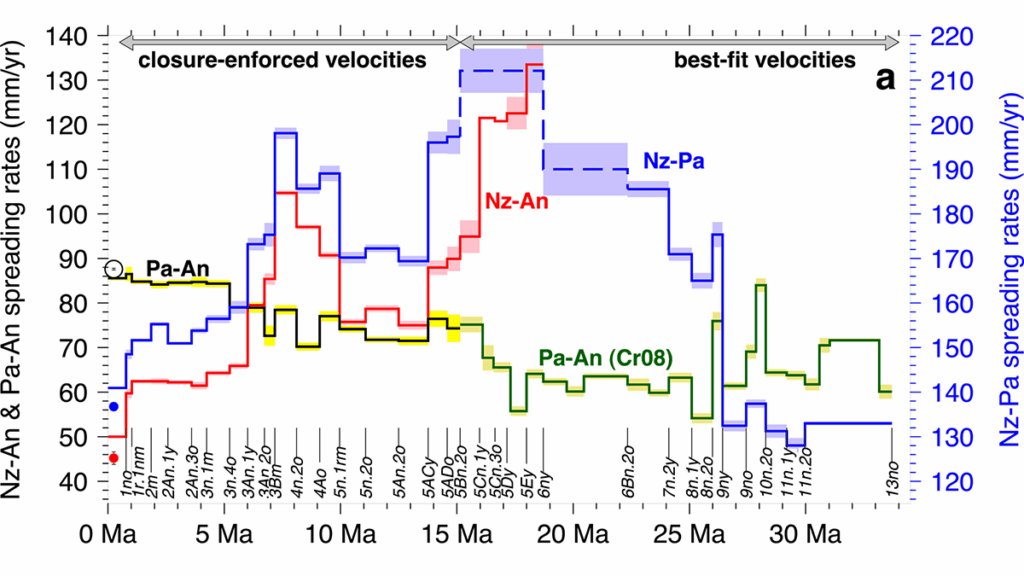
Wilson and DeMets [2025] present the most detailed reconstruction of changes in motion of the Nazca Plate to date. Remarkably, their results show periods of constant motion separated by geological short periods of rapid acceleration or deceleration. These changes coincide with changes in the dip of the Nazca plate where it subducts beneath South America, with decelerations occurring when multiple regions of the slab shallowed to anomalously low dips (“flat slab subduction”), and accelerations occurring when the slab deepened to normal dips. These results imply that changes in the forces acting between plates are an important control on plate motion.
Citation: Wilson, D. S., & DeMets, C. (2025). Changes in motion of the Nazca/Farallon plate over the last 34 million years: Implications for flat-slab subduction and the propagation of plate kinematic changes. Journal of Geophysical Research: Solid Earth, 130, e2025JB031933. https://doi.org/10.1029/2025JB031933
—Donna Shillington, Associate Editor, JGR: Solid Earth
Text © 2025. The authors. CC BY-NC-ND 3.0
Except where otherwise noted, images are subject to copyright. Any reuse without express permission from the copyright owner is prohibited.